
Agentic Commerce Is Here: What the Universal Commerce Protocol Means for Online Sellers
Last Updated:
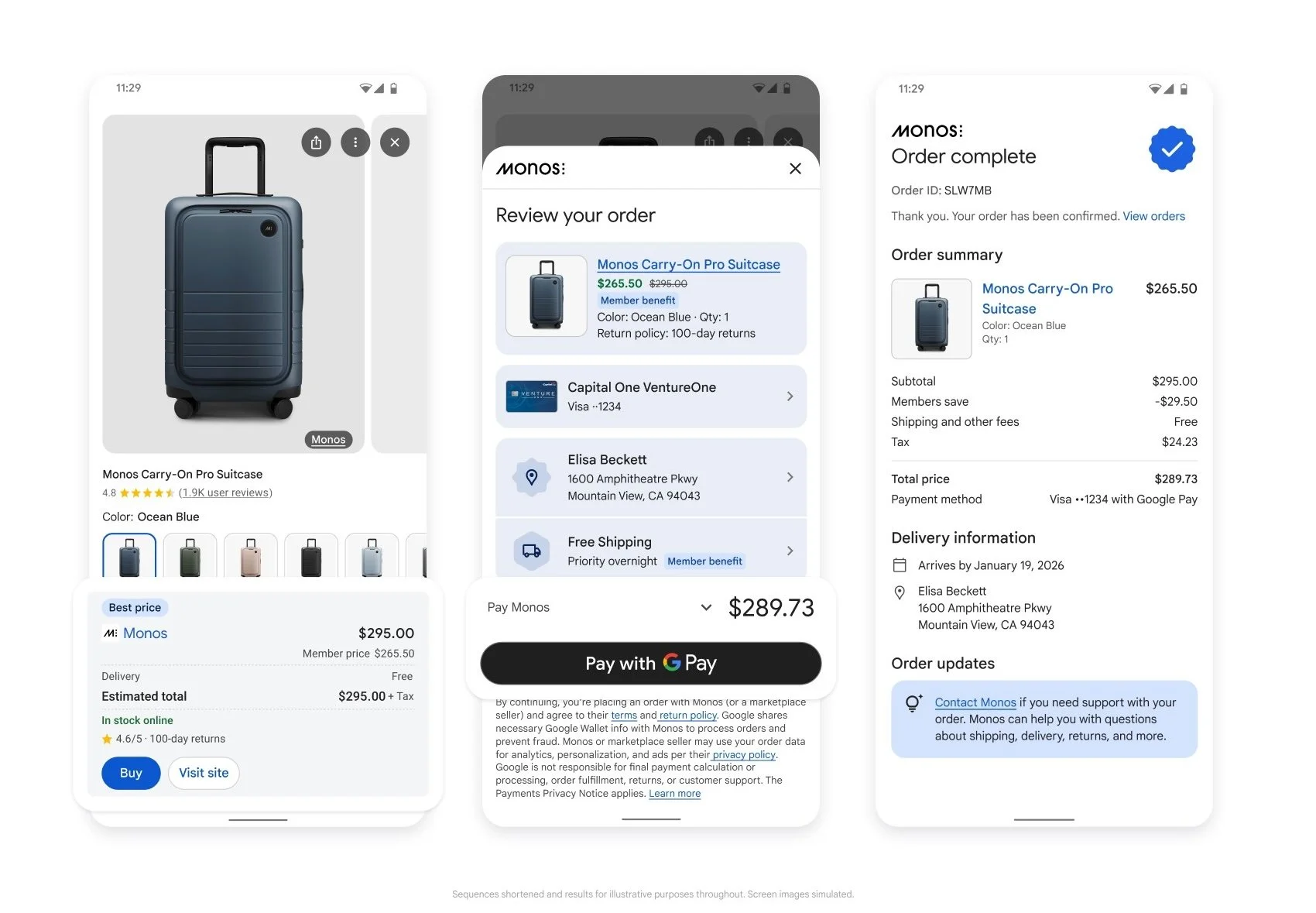
Agentic commerce has firmly arrived. What only a year ago felt like a far off reality, perhaps even something out of a science fiction novel, is now going live across the world’s largest consumer platform: Google.
Following OpenAI’s announcement of the Agentic Commerce Protocol (ACP) back in September, it was inevitable that Google would respond. That response is the Universal Commerce Protocol (UCP), which enables agentic purchasing directly inside Google Gemini and AI Mode.
This is not just big tech battling it out. There is clear and growing consumer demand behind it.
According to Capital One Research, 76% of consumers want AI powered shopping assistants. Morgan Stanley estimates that by 2030, as much as $385 billion of US ecommerce revenue could be transacted by agents. Google’s launch will only accelerate this adoption.
So what exactly is the Universal Commerce Protocol, and how should brands prepare for the era of agentic shopping?
What is the Universal Commerce Protocol?
UCP defines a shared set of building blocks for agentic commerce. These cover the full commerce journey, from product discovery and purchase through to post purchase experiences.
The core goal is interoperability. Businesses can connect to agentic shopping surfaces through a single standard, without needing to build bespoke integrations for every AI platform.
UCP is surface agnostic by design. It supports businesses of all sizes, from small merchants to global enterprises, and works across chat, visual commerce, and voice.
At a practical level, UCP creates a common language between consumer facing AI surfaces, such as Google Search AI Mode or Gemini, and merchant backends that handle products, carts, and checkout. This connection is standardised and secure.
The first reference implementation of UCP is now live inside Google Gemini and AI Mode.
How it works under the hood
UCP breaks commerce into services and capabilities.
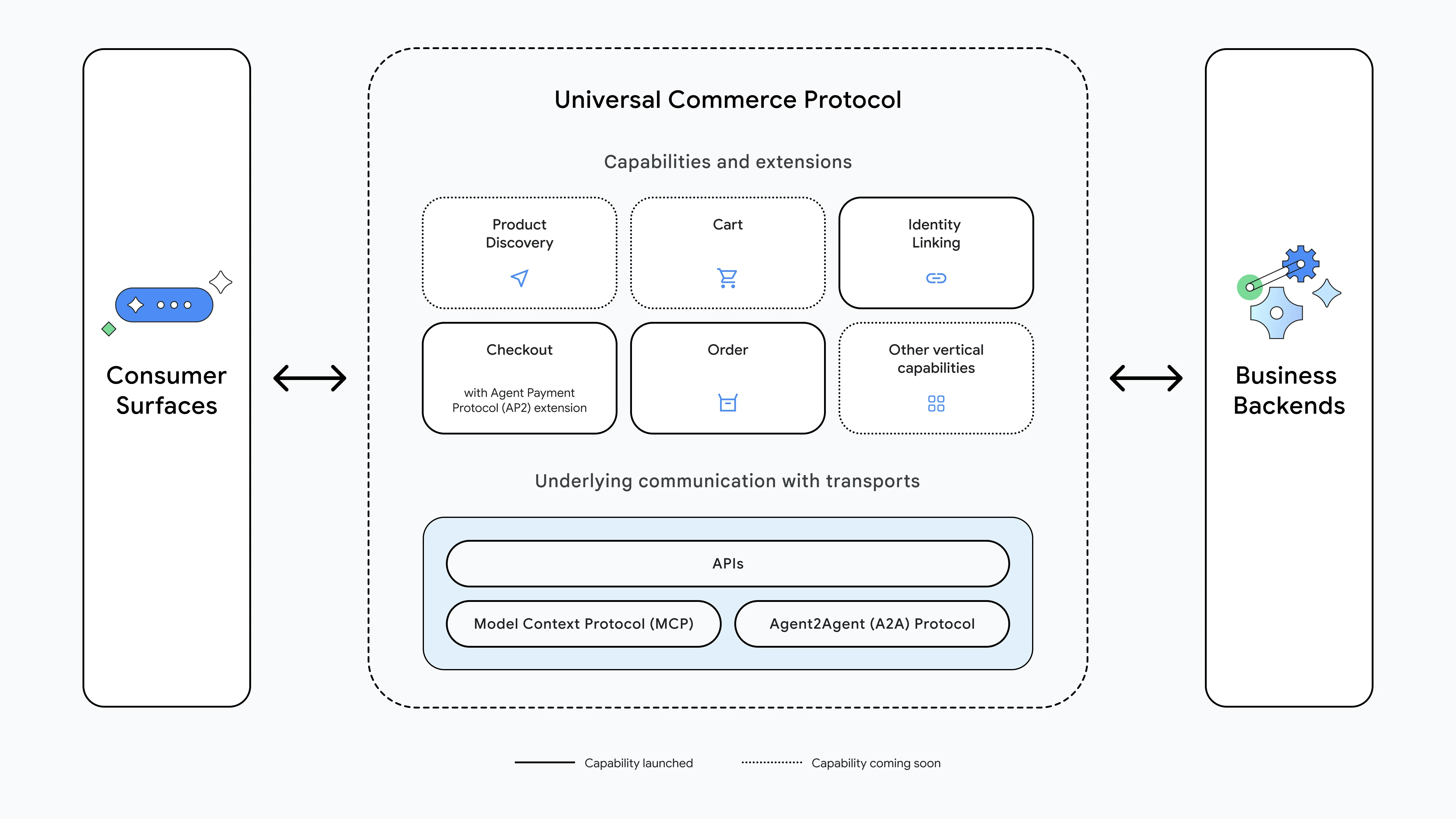
Businesses and agents choose which services they support, such as Shopping or other commerce verticals. Each service exposes a set of capabilities.
Capabilities represent core actions like product discovery, cart creation, or checkout. These can be extended with specialised logic, such as discounts, loyalty programmes, or subscriptions.
UCP includes a discovery mechanism that allows agents to dynamically understand what a business supports. This includes available capabilities and payment options, based on published profiles.
Payments follow a modular architecture. Payment instruments, such as cards or wallets, are separated from payment handlers or processors. This allows UCP to work with a wide range of existing payment providers.
UCP also supports multiple transport methods, including REST APIs, Model Context Protocol (MCP), Agent2Agent (A2A), and Agent Payments Protocols. This gives businesses flexibility in how they integrate based on their technical stack.
Co-developed by industry leaders
UCP has been co developed with major commerce platforms and retailers, including Etsy, Target, Wayfair, Walmart, and most notably, Shopify.
Shopify’s role
For Shopify merchants, UCP support is built in. Agentic commerce can be enabled directly from the Shopify Admin, with no custom protocol implementation required.
Non Shopify brands are also included. Through Shopify’s new Agentic plan, brands can upload products to the Shopify Catalogue and distribute them across AI shopping surfaces.
This positions Shopify as a core infrastructure layer for agentic commerce, not just a storefront provider.
Amazon: the notable absence
One notable absence is Amazon. After blocking OpenAI from crawling its site, Amazon is clearly choosing to keep the agent-led buying experience on its own platform through Rufus, rather than adopt an open standard.
ACP vs UCP: what’s the difference?
We already mentioned that OpenAI where the first movers in this space with the agentic commerce protocol that launched back in September. So you may be wondering how Google's new protocol differs in composition.
At a surface level, ACP and UCP enable the same user experience: a Buy Now action inside AI interfaces. ACP powers purchases inside ChatGPT, while UCP powers purchases inside Gemini and Google AI Mode.
However, the key differences lie in architecture and philosophy.
Core differences between ACP and UCP
Dimension | OpenAI – ACP | Google – UCP |
|---|---|---|
Design philosophy | Centralised and opinionated | Decentralised and ecosystem driven |
Discovery model | Centralised merchant listing via OpenAI | Capability based discovery via published profiles |
Payments | Tightly integrated with Stripe | Payment provider agnostic |
Scope | Focused on ChatGPT flows | Designed for broad ecosystem use |
Merchant exposure | Controlled by OpenAI | Can be published by merchants (in theory) |
Initial surfaces | ChatGPT | Gemini and Google AI Mode |
In practice today, merchants selling on Gemini still go through Google Merchant Center, so decentralised discovery is limited. However, the underlying architecture leaves room for a more open ecosystem over time.
Other key launches from Google (Ads in AI Mode + Business Agent
Alongside UCP, Google has announced several related commerce initiatives.
Business Agent is a branded AI assistant that lets shoppers chat directly with retailers on Search. It acts as a virtual sales associate, answering questions in a brand’s voice at high intent moments.
On the monetisation side, Google is introducing Direct Offers, a new Google Ads pilot inside AI Mode. This allows advertisers to surface exclusive discounts when AI detects a shopper is close to buying. Over time, this will expand to bundles, free shipping, and other incentives.
How to get started with the Universal Commerce Protocol
Today, the two most practical ways to adopt UCP are through Google and Shopify. Both provide production ready paths into agentic commerce.
Getting started with Google
Google’s UCP implementation is live across Gemini and AI Mode in Search.
Requirements
To participate, brands need:
An active Google Merchant Center account
Products eligible for checkout
Structured, accurate product data
Setup steps
Set up or verify your Merchant Center account
Upload and validate your product feed
Complete Google’s merchant interest form
Follow the UCP integration guide
Once approved, products can be discovered and purchased directly inside conversational shopping experiences.
Getting started with Shopify
For most brands, Shopify is the fastest route to UCP.
Shopify manages agentic commerce centrally through the Shopify Admin.
For Shopify merchants
No custom UCP build required
Agentic commerce enabled from Admin
Products sold directly in Google AI Mode, Gemini, ChatGPT, and Microsoft Copilot
Checkout, payments, inventory, and policies remain fully merchant controlled.
For non Shopify brands
Through Shopify’s Agentic plan, non Shopify brands can:
Upload products to the Shopify Catalogue
Use Shopify’s checkout infrastructure
Sell across AI channels without migrating their ecommerce stack
The new reality for brands and retailers
Agentic commerce fundamentally changes what optimisation means.
Optimising for humans alone is no longer enough. Brands now need to optimise for AI agents that discover, compare, recommend, and purchase on a user’s behalf.
This shift has several practical implications.
1. Machine readable clarity matters more than brand storytelling
Agents prioritise clarity over creativity. They do not infer meaning or fill in gaps the way humans do.
Clear, explicit information is favoured over vague or emotional language
Claims must be supported by structured facts, not marketing copy
Ambiguity is treated as risk
If agents cannot confidently understand what a product is, who it is for, or how it should be used, it is less likely to be surfaced or recommended.
2. Product data must be structured, accurate, and consistent
Agents rely on structured data to retrieve and compare products at scale.
Inconsistent attributes across platforms create uncertainty
Missing fields reduce eligibility for agent driven checkout
Conflicting information is more likely to be excluded than interpreted
Consistency across your website, product feeds, marketplaces, and third party sources is now critical.
3. Measurement shifts away from last click attribution
Agentic systems do not behave like traditional funnels.
Influence often happens upstream, long before a purchase is triggered. As a result:
Last click attribution becomes less meaningful
Visibility inside agent workflows becomes the key signal
Being surfaced, cited, or shortlisted matters more than direct traffic
Brands need to start tracking where and how they appear inside AI generated recommendations, not just where clicks come from.
What sellers can do to prepare today
Optimising for agentic commerce means helping AI agents understand, trust, and recommend your products.
This requires action across three areas: content, context, and authority.
1. Content: make products easy for agents to understand
Agents need detailed, explicit information about what you sell.
Actionable steps:
Create complete product specifications for every SKU
Add clear feature lists and benefit summaries
Build structured FAQ sections that answer common buyer questions
Include certifications, compliance details, and safety information
Define use cases and outcomes explicitly
As a rule of thumb, anything a customer might ask in a chat should already be answered in your product data.
2. Context: explain who the product is for and when it should be used
Agents need context to match products to intent.
Actionable steps:
Define target user types clearly
Specify when and where the product should be used
List compatibility details, such as sizes, devices, systems, or accessories
Clarify exclusions, limitations, or edge cases
The goal is to reduce guesswork. Agents should not need to infer suitability.
3. Authority: make your brand credible to AI systems
Agents favour brands they recognise as trustworthy.
This is driven by both owned and earned signals.
Actionable steps:
Publish consistent, high quality content across your owned channels
Add organisational schema markup to your site
Ensure brand information is accurate across key platforms
Build earned mentions in sources AI systems commonly reference
Monitor where your brand is cited and where it is missing
Authority is no longer about backlinks. It is about being present in the sources agents already trust.
4. Structured data: the foundation of agentic commerce
Structured data underpins everything.
Agents rely on it to retrieve, compare, and transact with products.
Actionable steps:
Implement and validate product schema markup
Maintain clean, complete product feeds
Ensure pricing, availability, and identifiers are always up to date
Align data across your site, Merchant Center, and third party platforms
Google is already expanding Merchant Center feeds with dozens of new attributes. Brands that fully populate these fields will be better positioned for agent driven discovery and checkout.
5. Prepare for new visibility metrics
Traditional analytics will not show how agents see your brand.
Actionable steps:
Track how often your brand is mentioned in AI responses
Monitor inclusion and exclusion in agent recommendations
Measure visibility across different AI platforms and regions
Treat agent visibility as a top of funnel metric
In an agentic world, being chosen matters more than being clicked.
This is where Azoma comes in.
Azoma gives brands visibility into how they appear across AI systems. It shows when and where your brand and products are being surfaced, cited, or missed by large language models and agentic interfaces.
Beyond tracking, Azoma helps brands optimise their product listings for agentic commerce. By analysing how agents interpret product data, Azoma highlights gaps in structure, clarity, and consistency that can prevent products from being recommended or selected. This allows teams to improve feeds, metadata, and product attributes in ways that directly impact agent driven discovery and checkout.
As commerce shifts from clicks to conversations, tools like Azoma help brands understand not just what users see, but how agents decide. 👉 If you'd like to learn more, reach out to Azoma today for a demo of our platform. 👈

Article Author: Max Sinclair