
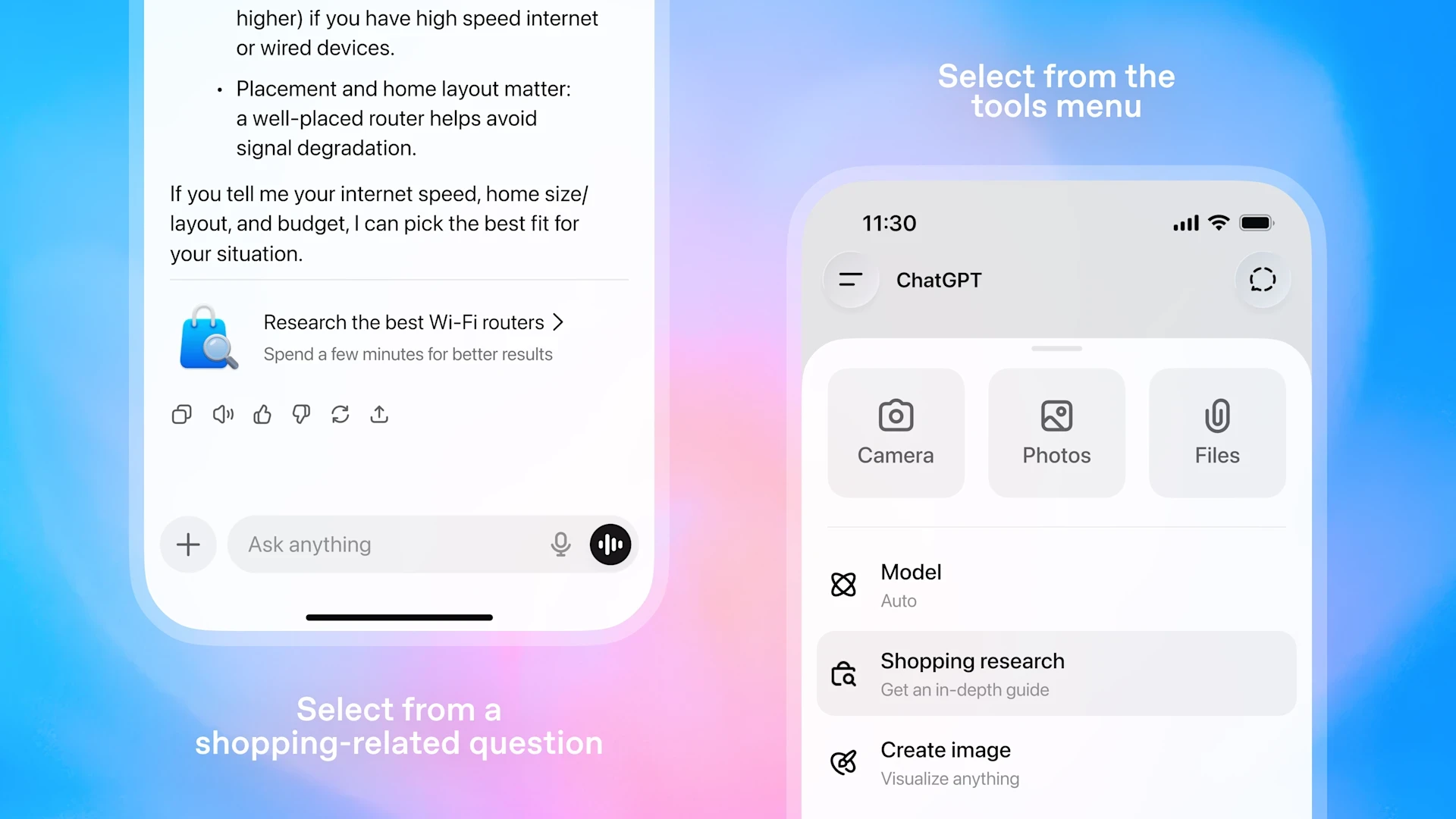
OpenAI launched Shopping Research on November 24, 2025, introducing a dedicated shopping experience powered by a reinforcement-trained variant of GPT-5 mini that fundamentally changes how 700 million ChatGPT users discover products. Unlike previous AI shopping features that scraped product pages and compiled basic recommendations, Shopping Research actively prioritizes "trusted sites" like Reddit over brand-owned content and retailer listings, creating an entirely new visibility paradigm for eCommerce.
The feature processes 50 million shopping queries daily, but here's what brands need to understand: Amazon has blocked all OpenAI crawlers from accessing its site, meaning 40% of U.S. eCommerce is invisible to ChatGPT's shopping recommendations. This creates both a massive opportunity for brands selling through other channels and an urgent imperative to optimize for the specific signals ChatGPT now values most.
The Trust Hierarchy Revolution: Why ChatGPT Trusts Reddit More Than Retailers
OpenAI's Shopping Research represents a deliberate shift in how AI evaluates product information. According to OpenAI representatives briefing reporters, the system explicitly considers "user experiences shared on Reddit may be considered more trustworthy than paid marketing or reviews posted on a product page." This isn't a bug—it's the core feature.
Isa Fulford, who leads OpenAI's Shopping Research team, acknowledged during the press briefing that teaching the model to identify objective, unpaid reviews has been "a pretty hard task" and that it's "impossible to get it 100% correct." The solution? Default to sources less likely to contain paid content. As OpenAI researcher Manuka Stratta stated directly: "Generally a lot of reviews on Reddit are pretty trustworthy."
This creates an unprecedented dynamic. A single Reddit thread discussing your product now carries more weight in ChatGPT's recommendations than your meticulously optimized product pages. When asked "find the quietest cordless stick vacuum for a small apartment," ChatGPT synthesizes discussions from r/VacuumCleaners before it considers manufacturer specifications.
The model achieves 64% accuracy in matching products to user requirements—a significant improvement over the 37% success rate of previous ChatGPT shopping queries. But this accuracy comes from prioritizing community discussion over commercial content, fundamentally inverting traditional SEO principles.
Amazon's Strategic Blockade: The 40% Visibility Gap
Amazon's decision to block OpenAI's crawlers creates the most significant structural shift in AI shopping visibility. The retailer quietly updated its robots.txt file to disallow multiple OpenAI agents:
ChatGPT-User: The agent fetching live information when users ask questions
OAI-SearchBot: Powers OpenAI's SearchGPT search engine
GPTBot: The web crawler for model training
According to eCommerce analyst Juozas Kaziukėnas who first spotted the changes, "Amazon doesn't want to just be the back end of the internet. They want to be the front door." With Amazon generating $56 billion annually from advertising—a business model that depends on shoppers browsing Amazon.com rather than getting recommendations through ChatGPT—the blockade protects critical revenue streams.
For brands, this creates a complex dynamic. Products exclusively sold on Amazon become invisible to ChatGPT Shopping Research. During testing, when users asked for specific Amazon products, ChatGPT suggested they "manually check if they're available on Amazon"—essentially admitting blindness to the world's largest eCommerce platform.
Yet Amazon CEO Andy Jassy stated on the Q3 2025 earnings call that Amazon is "having conversations" with third-party shopping agents and expects to "find ways to partner" over time. Until then, brands face a choice: maintain Amazon exclusivity and forfeit ChatGPT visibility, or diversify distribution to capture AI-driven discovery.
The Reinforcement Learning Advantage: How GPT-5 Mini Changes Product Discovery
Shopping Research runs on a specialized version of GPT-5 mini trained specifically for shopping tasks through reinforcement learning. OpenAI states: "We trained it to read trusted sites, cite reliable sources, and synthesize information across many sources to produce high-quality product research."
The system employs several sophisticated mechanisms:
Interactive Refinement: Users swipe Tinder-style on product recommendations, with the model updating suggestions in real-time based on feedback. This creates a personalized discovery loop that traditional search cannot replicate.
Constraint Handling: The model excels at managing multiple requirements simultaneously. A query like "lightweight laptop under $1,000 for video editing with good battery life" triggers deep analysis across specifications, reviews, and discussions to identify products meeting all criteria.
Memory Integration: For logged-in users with memory enabled, Shopping Research incorporates past conversations and preferences. If you've previously discussed needing equipment for a small apartment, future queries automatically factor in space constraints.
Source Synthesis: Rather than presenting individual product pages, the model creates comprehensive buyer's guides that highlight trade-offs, compare specifications, and surface insights from multiple sources—with community discussions weighted heavily.
The three-to-five minute processing time reflects the depth of analysis. This isn't keyword matching; it's structured reasoning across disparate information sources to build coherent recommendations.
Platform Dynamics: Who's In and Who's Out
The current Shopping Research ecosystem reveals clear winners and losers:
Integrated Partners:
Shopify: Full integration coming, with major brands like Glossier, SKIMS, and Spanx already enabled
Etsy: Live now for U.S. sellers with Instant Checkout support
Walmart: Deep partnership including future Instant Checkout integration
Target: Announced plans to launch their app inside ChatGPT
Limited Visibility:
Temu: Stratta confirmed Temu "isn't going to be recommended that much" unless users specifically request it
Amazon: Completely blocked from crawling, products only mentioned if discussed on other sites
Crawling Allowed (Non-partnered):
Most independent retailers with proper robots.txt configuration
Brands with strong editorial and community presence
Sites that haven't explicitly blocked OpenAI crawlers
This fragmentation means visibility strategies must account for platform-specific dynamics. A product might dominate Amazon search but remain invisible to ChatGPT, while a lesser-known brand discussed extensively on Reddit could capture AI recommendations.
The New Optimization Framework: Eight Critical Actions for ChatGPT Shopping Visibility
Based on OpenAI's technical documentation and observed recommendation patterns, brands must implement these specific optimizations:
1. Cultivate Authentic Reddit Presence
Since Reddit discussions carry disproportionate weight, brands need genuine community engagement:
Monitor relevant subreddits for organic mentions
Respond to questions with helpful, non-promotional information
Encourage satisfied customers to share experiences in appropriate threads
Never astroturf—the community and AI both detect inauthentic content
According to OpenAI's own statements, Reddit reviews are considered inherently more trustworthy than retailer-hosted reviews. A single detailed Reddit post about your product's real-world performance outweighs dozens of five-star ratings on your site.
2. Diversify Distribution Beyond Amazon
With Amazon blocking ChatGPT crawlers, exclusive Amazon sellers forfeit AI visibility entirely. Strategic responses:
Establish direct-to-consumer sales through Shopify
List on Etsy for immediate Instant Checkout access
Partner with retailers that allow OpenAI crawling
Maintain product availability across multiple channels
Modern Retail reports Walmart now receives 36% of its referral traffic from ChatGPT, up from 20% initially—evidence of real traffic value from AI visibility.
3. Optimize for Constraint-Based Queries
Shopping Research excels at multi-constraint queries. Structure content to address:
Budget ranges ("under $200")
Use cases ("for small apartments")
User types ("for teenage gamers")
Feature requirements ("with good battery life")
Occasions ("for four-year-old who loves art")
Each product description should explicitly state which constraints it satisfies. Don't assume the AI will infer—be explicit about every relevant attribute.
4. Generate Editorial Coverage and "Best Of" Lists
The model synthesizes information from "high-quality, publicly available" sites. Prioritize:
Inclusion in legitimate buying guides from recognized publications
Editorial reviews from established media outlets
Comparisons and round-ups from trusted tech sites
YouTube reviews from credible channels
These citations provide the "trusted source" signals the model seeks when building recommendations.
5. Implement Comprehensive Structured Data
While not explicitly partnered, sites with proper schema markup see better representation:
Complete Product schema with all specifications
Offer schema with real-time pricing and availability
AggregateRating and Review schemas
BreadcrumbList for site structure clarity
OpenAI's crawler needs clean, machine-readable data to accurately represent products when they appear in community discussions.
6. Develop Interactive Content Strategies
Since Shopping Research takes 3-5 minutes to generate guides, it targets considered purchases. Create:
Detailed comparison tools on your site
Interactive product selectors
Comprehensive FAQ sections
Use case galleries showing real applications
This content feeds the synthesis engine when ChatGPT researches your category.
7. Monitor Robots.txt Configuration
Ensure your robots.txt explicitly allows:
OAI-SearchBot
ChatGPT-User
GPTBot
Many sites inadvertently block these crawlers through overly restrictive rules. OpenAI states the system only surfaces information from sites permitting access.
8. Build Category Authority Through Content Depth
Shopping Research performs "especially well in detail-heavy categories like electronics, beauty, home and garden, kitchen and appliances, and sports and outdoor." For these categories:
Publish technical deep-dives on product capabilities
Create video demonstrations of key features
Document real-world performance metrics
Address common concerns and trade-offs
The model values comprehensive information that helps users understand complex purchase decisions.
Performance Metrics: The Early Returns
While Shopping Research just launched, early indicators suggest significant impact. OpenAI reports the specialized GPT-5 mini model achieves 64% accuracy in matching products to requirements, compared to 37% for standard ChatGPT queries. This 73% improvement in relevance drives user adoption.
The company offers "nearly unlimited usage" through the holiday season, expecting massive query volumes. With 50 million shopping-related queries daily already, even small improvements in visibility can drive substantial traffic.
For context, similar AI shopping implementations show strong returns:
Amazon Rufus: 250 million users, 60% higher purchase likelihood
Walmart referral traffic from ChatGPT: 36% of total, up from 20%
Target's AI features: 11% interaction rate increase, 12% display-to-conversion improvement
These metrics suggest Shopping Research will rapidly become a significant discovery channel, particularly for considered purchases in complex categories.
The Strategic Imperative: First-Mover Advantages in Trust-Based Discovery
Shopping Research represents more than another AI feature—it's a fundamental shift from authority-based to trust-based product discovery. When Reddit discussions outweigh retailer content, when Amazon products become invisible, and when community sentiment drives recommendations, traditional optimization fails.
Brands that adapt quickly gain compounding advantages:
Community Authority: Early authentic engagement on Reddit and forums establishes your products in trusted discussions the AI prioritizes
Cross-Platform Presence: Diversifying beyond Amazon captures the 700 million ChatGPT users now shopping through AI
Editorial Momentum: Securing coverage in publications ChatGPT considers "high-quality" creates lasting visibility signals
Technical Readiness: Proper crawler access and structured data ensure accurate representation when synthesized
The three-to-five minute processing time Shopping Research requires indicates its focus on considered purchases—exactly where brand differentiation and trust signals matter most. This isn't about winning quick transactional searches; it's about becoming the trusted recommendation when users invest time in research.
Partner with Azoma to Navigate the Trust Economy
The shift from search-based to trust-based discovery demands new visibility strategies. Azoma.ai helps brands optimize for ChatGPT Shopping Research through:
Real-time monitoring of AI recommendations across shopping queries
Reddit and community platform sentiment analysis and engagement strategies
Multi-channel visibility tracking beyond Amazon-exclusive metrics
Structured data implementation optimized for AI comprehension
Editorial outreach programs targeting ChatGPT's trusted sources
Competitive intelligence on which brands appear in AI shopping guides
As Shopping Research rolls out globally and Instant Checkout integration expands, brands optimized for trust-based discovery will capture disproportionate share. With Amazon blocking access and Reddit driving recommendations, the rules have fundamentally changed.
Contact Azoma.ai today to develop your ChatGPT Shopping Research visibility strategy and ensure your products appear in the AI-generated buyer's guides that increasingly drive purchase decisions.

Article Author: Max Sinclair