
2026 AI & Ecommerce Predictions (Agentic Commerce, AI Wearables, The Death of Prompting and more)
Last Updated:
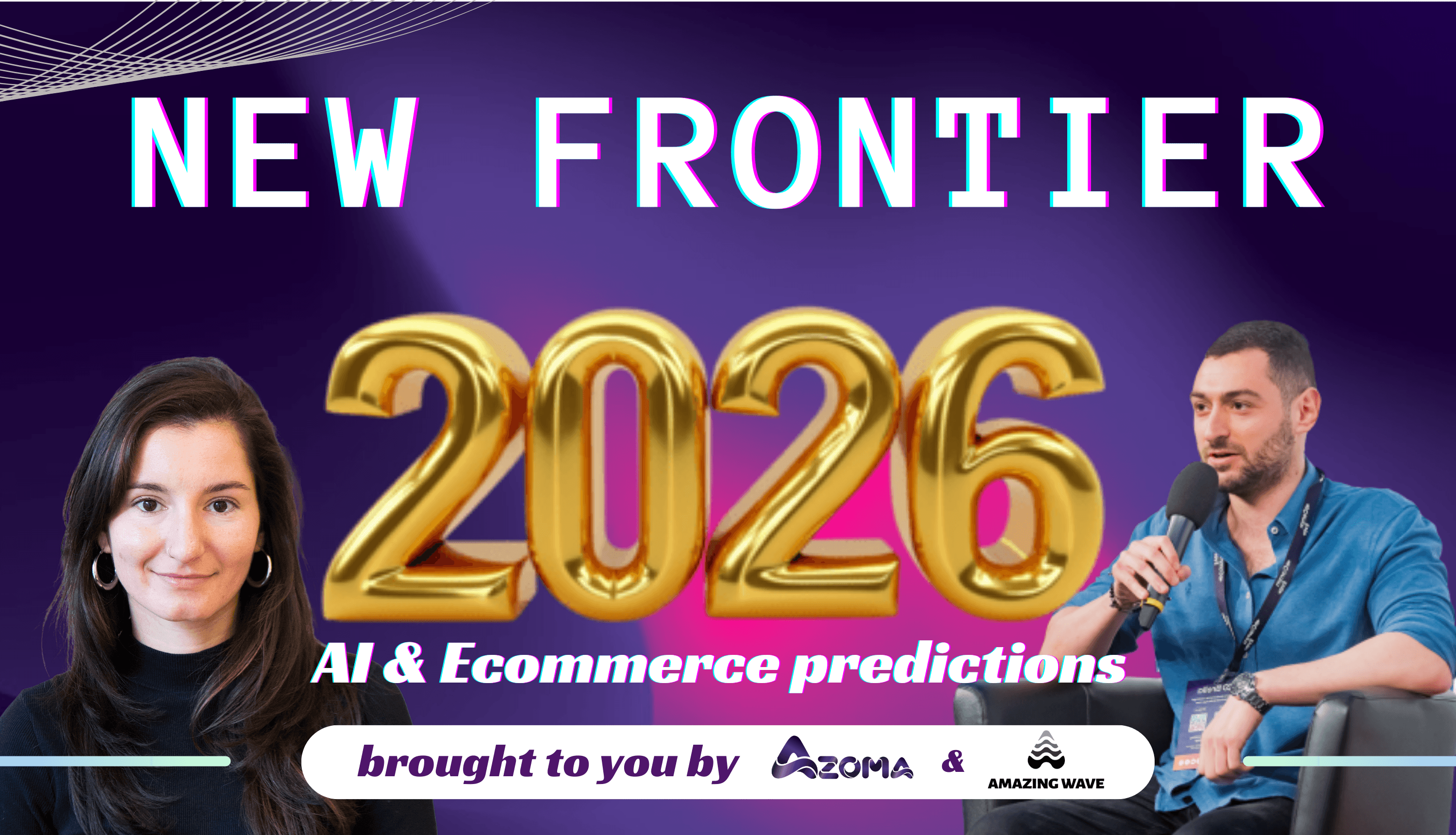
As we step into 2026, the AI landscape continues to evolve at breakneck speed. On their podcast The New Frontier, Founder & CEO of Azoma Max Sinclair sits down with co-host AI influencer Joanna Lambadjieva to discuss their top predictions for the coming year (listen on Spotify or Apple). From the explosion of agentic shopping to the surprising comeback of human creativity, this year promises to reshape how we interact with technology, consume content, and conduct business. Here are the key AI and e-commerce predictions that will define 2026.
Agentic Commerce Takes Over
The biggest transformation of 2026? Agentic shopping isn't just growing, it's fundamentally rewriting the rules of e-commerce. With Amazon's Rufus already accounting for 38% of searches by the end of 2025 (far exceeding early predictions of 5-10%), we're witnessing the death of traditional search-based shopping.
The bold prediction for 2026: the search bar will disappear entirely. Amazon and other major platforms will feel more like ChatGPT: conversational, predictive, and proactive. Instead of typing "waterproof hiking boots size 10," you'll simply tell Rufus about your upcoming trip, and it will understand context, preferences, and past purchases to curate perfect recommendations. This shift represents more than a UI change. It's a complete reimagining of how consumers discover and purchase products. For brands, this means visibility strategies must evolve from keyword optimization to conversational relevance and contextual understanding. Book in a call with the Azoma team to find out more about how you can adapt.
Personalization Finally Becomes Reality
Building on agentic commerce, 2026 marks the true arrival of hyper-personalization across all digital experiences. Products, services, and content will stop being general and start being individually tailored. E-commerce recommendations from Rufus, ChatGPT, and other AI assistants will be completely unique to each user. Beyond shopping, expect AI tutors that adapt to individual learning paces, healthcare plans customized to your specific needs, and workout programs that evolve with your progress.
This personalization revolution presents new challenges for brands and marketers. Generic visibility rankings become meaningless when every user sees different results. The question shifts from "Are we ranked #1?" to "Are we visible to our specific audience segments?" Success will require understanding not just what you're selling, but precisely who you're selling to and how AI interprets those connections.
AI Wearables and the Data Revolution
2026 will see AI wearables move from early adopter curiosity to mainstream adoption. With Meta, Snapchat, Google, Amazon, and potentially Apple all launching AI glasses or wearables, these devices will fundamentally change how we generate and consume data. OpenAI's upcoming pocket device, reminiscent of an iPod shuffle that records everything, exemplifies this shift toward ambient AI that's always listening, always learning.
The implications are staggering. Imagine walking past a shoe store, your gaze lingering on a particular pair for just a moment longer than usual. Meta's glasses register this micro-interaction, and suddenly similar styles begin appearing in your social feeds. Every conversation becomes a data point, every glance a signal of intent. Amazon's new Alexa with visual capabilities already demonstrates this convergence: it doesn't just hear what you say, it sees what you're looking at, creating an unprecedented stream of behavioral data. Companies that can responsibly leverage this ambient data while respecting user boundaries will gain significant competitive advantages.
World Models Transform Digital Reality
Interactive video and world models represent the next frontier beyond large language models. These systems can generate entire 3D environments from a single image, maintaining perfect consistency as users explore them. Companies like World Labs and DeepMind's Genie 3 are pioneering technology that remembers spatial relationships, allowing you to walk through a generated environment and return to find everything exactly where it should be.
The implications extend far beyond gaming. We're approaching a world where AI-generated video content will exceed 30 minutes in length, up from mere seconds just three years ago. YouTube channels are already transforming historical paintings into immersive experiences, letting viewers "walk through" 17th century London or experience life in ancient Rome. Perhaps most significantly, these world models will accelerate robotics development exponentially. Unlike current AI that learns primarily from text, world models understand physics, motion, and spatial relationships. This convergence of digital and physical understanding will enable robots that can navigate our world in ways that seemed impossible just years ago.
The Great AI Consolidation
After three years of explosive growth in AI startups, 2026 marks the beginning of significant industry consolidation. Meta's acquisition of Perplexity signals a fundamental shift: major players are choosing to buy innovation rather than build it internally. This trend will accelerate dramatically as companies realize the talent and time required to compete in AI's rapidly evolving landscape.
Apple, conspicuously behind in the AI race, is positioned to become the most aggressive acquirer. Standout platforms like Genspark, which consistently outperforms ChatGPT in research tasks, represent prime targets. The exodus of talent from OpenAI has created a diaspora of new labs and specialized tools, many with unique capabilities but lacking resources to scale. As larger companies absorb these innovations, we'll see rapid integration into unified platforms. The era of using multiple AI tools for different tasks will give way to comprehensive platforms combining the best innovations from across the industry.
The Death of Prompting
Perhaps the most radical transformation of 2026: the traditional act of prompting AI will become obsolete. Instead of typing requests or crafting careful prompts, AI-native applications will observe user behavior patterns and intervene proactively. This isn't about better interfaces. It's about AI that acts before you ask, understanding intent from context rather than explicit instruction.
Consider a practical example: today, you log into invoicing software, navigate menus, input data, and generate an invoice. The chat interface generation would let you type "create an invoice for Client X." But the post-prompting world simply presents you with a ready-made invoice when you log in, having predicted your intent from calendar entries, email exchanges, and historical patterns. Your only action is to approve or modify what the AI has already prepared. While this future may not fully arrive in 2026, the foundations being laid now will fundamentally change our relationship with software from one of instruction to one of collaboration.
Looking Ahead
As we navigate 2026, the tension between AI efficiency and human authenticity will define much of our digital experience. While AI capabilities expand dramatically, from autonomous scientific discovery to AI influencer clones pumping out content, the human element becomes increasingly valuable precisely because of its scarcity.
The winners in 2026 won't be those who resist AI or those who blindly embrace it, but those who thoughtfully navigate this new landscape. For e-commerce brands, tech companies, and content creators alike, 2026 demands a strategic rethink: How do you maintain authenticity in an AI-saturated world? How do you ensure visibility when personalization makes every user's experience unique? The future isn't just about better AI. It's about better integration of AI into genuinely human experiences. Welcome to 2026.me to 2026.

Article Author: Max Sinclair