
AI Drove $14.2 Billion in Black Friday Sales as Rufus Usage Surged to 38%: What This Means for the future of commerce
Last Updated:
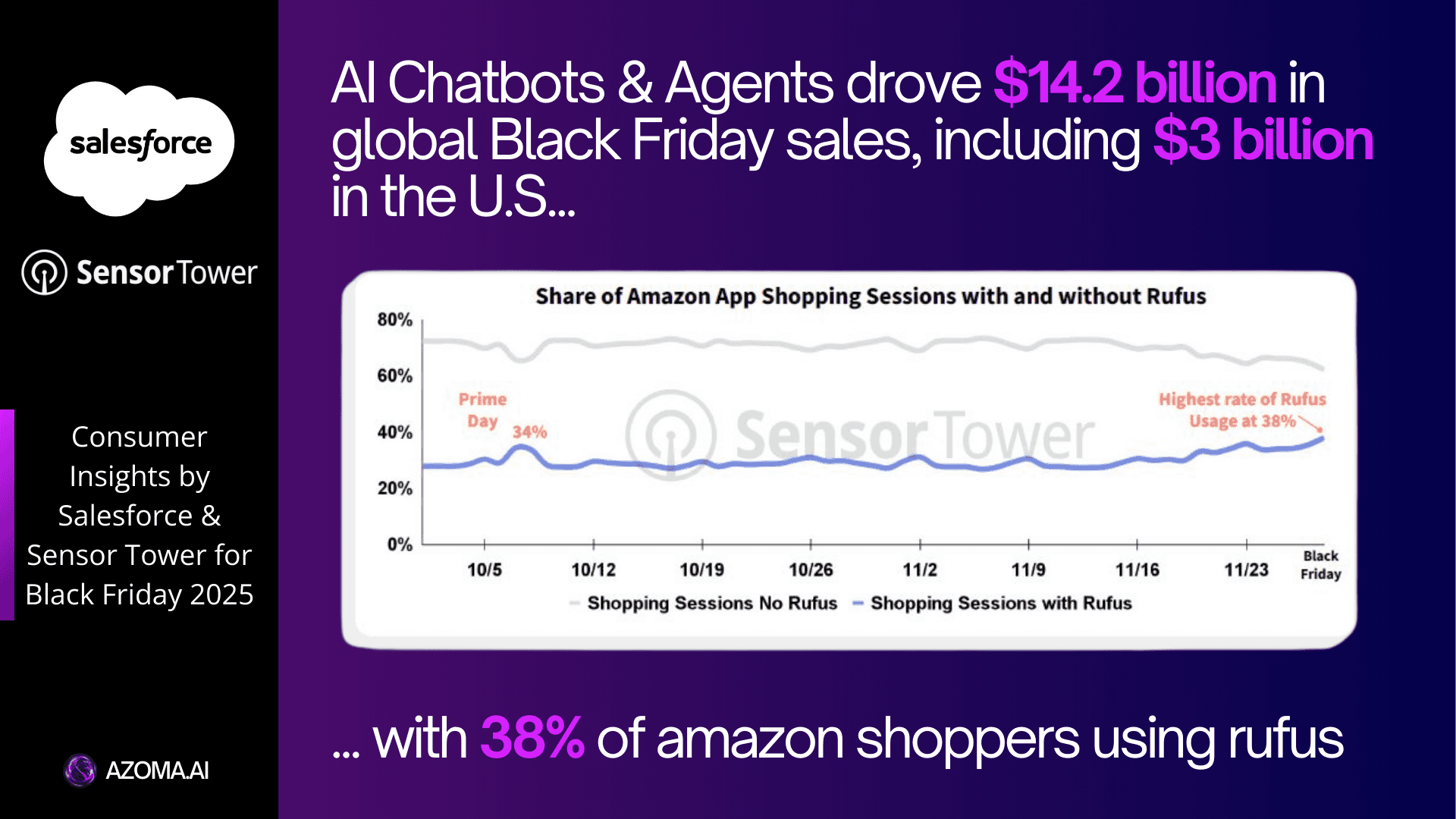
Black Friday 2025 marked a watershed moment for AI-powered commerce. While shoppers spent a record $11.8 billion online, the real story lies beneath the surface: AI chatbots and agents influenced $14.2 billion in global sales, with Amazon's Rufus assistant now being used in 38% of shopping sessions, up from minimal adoption just weeks earlier.
For brands, the message is unmistakable: AI shopping has reached critical mass. The systems that determine product visibility are shifting from traditional search to conversational AI, and the data proves brands that aren't optimizing for these systems are already losing ground.
AI Shopping Adoption Hit an Inflection Point
The numbers from Black Friday reveal AI shopping has crossed from experiment to mainstream adoption:
AI Traffic Explosion: Traffic from AI sources to retail websites skyrocketed 805% year-over-year, according to Adobe Analytics, which tracks over 1 trillion U.S. retail site visits. More critically, shoppers arriving from AI services were 38% more likely to convert than those from traditional traffic sources.
Rufus Dominance at Amazon: New data from Sensor Tower shows Amazon's Rufus assistant experienced a 70% usage surge between November 15 and Black Friday. By Black Friday itself, 38% of Amazon shopping sessions involved Rufus, up from around 30% just two weeks earlier. This acceleration is particularly striking given that prior to November 15, Rufus usage was essentially flat with non-Rufus sessions.
Salesforce's AI Agent Impact: Between Thanksgiving and Black Friday, AI and AI agents influenced $22 billion in global sales, with $14.2 billion on Black Friday alone, of which $3 billion came from U.S. shoppers. Retailers deploying AI agents on their websites saw 9% year-over-year sales growth on Thanksgiving, compared to just 2% growth for retailers without AI agents.
Conversion Rate Differential: The most compelling metric comes from Amazon itself. According to Andy Jassy's Q3 earnings call, customers using Rufus are 60% more likely to complete a purchase than those who don't. This aligns with Adobe's finding that AI-referred traffic converts at significantly higher rates.
Performance Metrics That Prove AI's Impact
The business case for AI optimization is no longer theoretical. Black Friday 2025 delivered concrete evidence:
Revenue Impact:
Rufus is expected to generate more than $10 billion in annual incremental sales for Amazon
AI-influenced sales reached $14.2 billion globally on Black Friday alone
Retailers using AI saw 5% higher conversion rates and 10% year-over-year sales growth, compared with 5% for those without
Traffic Patterns:
805% year-over-year increase in AI-driven traffic to retail sites
300% increase in traffic from third-party AI agent channels
42% increase in AI agent conversations from Thanksgiving to Black Friday
Adoption Trajectory:
Rufus usage growing from 30% to 38% of sessions in two weeks
Monthly active users more than doubling year-over-year with interactions up over 200%
At current growth rates, Rufus could exceed 50% of Amazon sessions by end of Q1 2025
Eight Optimization Steps Based on Black Friday Learnings
The convergence of data from Adobe, Salesforce, and Sensor Tower reveals clear optimization priorities:
1. Prioritize Semantic Richness Over Keywords
The 60% conversion lift from Rufus users shows AI understands meaning, not just terms. Transform your product content:
Before: "Comfortable walking shoes" After: "All-day comfort walking shoes for nurses and healthcare workers, tested for 12-hour shifts with memory foam insoles and slip-resistant soles"
2. Build for Conversational Discovery
With 38% of Amazon sessions now involving Rufus, products must be discoverable through natural language:
Include use case scenarios in descriptions
Answer the "who, what, when, where, why" explicitly
Include problem-solving language naturally
3. Optimize for AI Review Synthesis
Rufus's ability to synthesize reviews drives trust. According to Rankyung Park, Lead Data Scientist at Target, AI systems analyze review patterns to understand product strengths and weaknesses. Ensure your reviews:
Address common customer questions
Include specific use cases and scenarios
Maintain consistency in positive feedback
Resolve negative reviews promptly
4. Structure for Price Comparison
Despite AI sophistication, price remains dominant. Adobe's data shows price was a primary factor in Black Friday AI recommendations. Your pricing strategy must:
Clearly communicate value proposition
Include bulk or bundle options
Highlight cost-per-use metrics
Explain premium positioning explicitly
5. Create Cross-Platform Authority Signals
AI systems reference multiple sources. Products mentioned in "best of" lists, Reddit discussions, and YouTube reviews appear more frequently in recommendations. Build authority through:
Earned media in publications AI systems frequently cite
Authentic community engagement on Reddit and forums
Video content with detailed reviews and demonstrations
Consistent messaging across all platforms
6. Enable Multimodal Discovery
With AI systems processing images, text, and context together:
Add detailed alt text to all images
Include lifestyle photography showing products in use
Overlay key features directly on product images
Ensure packaging and branding are clearly visible
7. Implement Real-Time Inventory Integration
The surge in AI-driven traffic requires accurate availability data. According to the data, mobile accounted for 55.2% of Black Friday online sales, with shoppers expecting immediate gratification. Ensure:
Live inventory feeds to all platforms
Accurate stock levels in structured data
Alternative fulfillment options clearly stated
Regional availability properly configured
8. Monitor AI Performance Metrics
Use AI Visbility tools like Azoma to track your visibility across AI systems:
Test your products in Rufus, ChatGPT, and other assistants weekly
Monitor which queries surface your products
Track conversion rates from AI-referred traffic
Measure share of voice versus competitors in AI responses
The Competitive Reality: If You Are Reading This For The First Time, You Are Already Behind
Here's a combined, powerful single paragraph:
The Competitive Reality: You're Already Behind
The data should serve as a severe wake-up call to any brand still debating AI strategy. This isn't about first-mover advantage anymore, that window closed long before Rufus hiting 38% adoption and AI drove $14.2 billion in Black Friday sales. We're now in the elimination phase where algorithms are actively learning which brands to recommend for every product category and customer query. Every day without optimization is another day competitors cement themselves as the default AI recommendation. When Rufus usage surged 70% in two weeks and AI traffic grew 805% year-over-year, the trajectory is undeniable: by 2026, brands without AI optimization won't just be disadvantaged—they'll be invisible to the 700 million ChatGPT users who can't see their products and the 38% of Amazon sessions that bypass their listings entirely.
The playbooks are public - Target's data scientists detailed their algorithms, Amazon revealed Rufus's $10 billion impact, ChatGPT explicitly stated Reddit matters more than your product pages. At Azoma.ai, we're watching brands divide into two groups: those securing their AI visibility across every platform where customers shop, and those about to discover they've become permanently invisible to the majority of online shoppers.
The algorithms determining category leadership are being set right now—tomorrow, they'll know less about you than they do today. Get in touch to diagnose your AI visibility and build an emergency roadmap before irrelevance becomes permanent.

Article Author: Max Sinclair