
GPT-5.2 Explained: What eCommerce Brands Need to Know to Optimise Their Visibility
Last Updated:
Brief Article Overview
GPT-5.2 is a major upgrade that changes how ChatGPT discovers, evaluates, and cites brands
The model has stronger reasoning, lower hallucination rates, and long context understanding, making it more selective about what it trusts
Clear, consistent, and well structured product information is now essential for visibility
GPT-5.2 excels at comparisons, so brands that explain trade offs and use cases are more likely to be referenced
Improved vision and multimodal reasoning mean visuals and video matter more than ever
Early testing shows a stronger preference for video content, especially YouTube, in product recommendations
Detailed, experience based customer reviews carry more weight than generic praise
A smarter more accurate model to rival the competition
Following the widely praised launches of Gemini 3 and Claude Opus 4.5, OpenAI has responded with the release of its most capable model to date, GPT-5.2.
The launch is especially significant given the momentum behind Google’s Gemini 3 model and the continued enterprise adoption of Anthropic’s Claude and Opus 4.5. GPT-5.2 is a clear statement from OpenAI that it remains firmly at the forefront of the model race, despite claims from some that Gemini had effectively replaced ChatGPT as the market-leading LLM.
For eCommerce brands, this matters for one key reason. With more than 800 million active users, ChatGPT is increasingly shaping how products, brands, and retailers are discovered by consumers. Optimising for visibility within the latest ChatGPT models is no longer optional. It is becoming a core part of how brands should approach their digital marketing strategy.
So what makes GPT-5.2 different, and why does it change how brands should think about Generative Engine Optimisation?
Smashing through previous benchmarks
With GPT-5.2, OpenAI is positioning the model as a step change for knowledge workers, developers, and businesses. The improvements are reflected across major benchmarks, including:
SWE-bench, which measures real-world coding performance
GDPval, a benchmark designed to estimate a model’s economic and commercial value
On GDPval alone, OpenAI reports an improvement from 38.8 percent to 70.9 percent. This jump suggests stronger reasoning, better task completion, and more reliable outputs across complex workflows.
For eCommerce brands, higher benchmark performance translates directly into how confidently a model can summarise products, compare options, interpret reviews, and recommend retailers within generative answers.
So what has driven this leap in performance?
What’s new in GPT-5.2
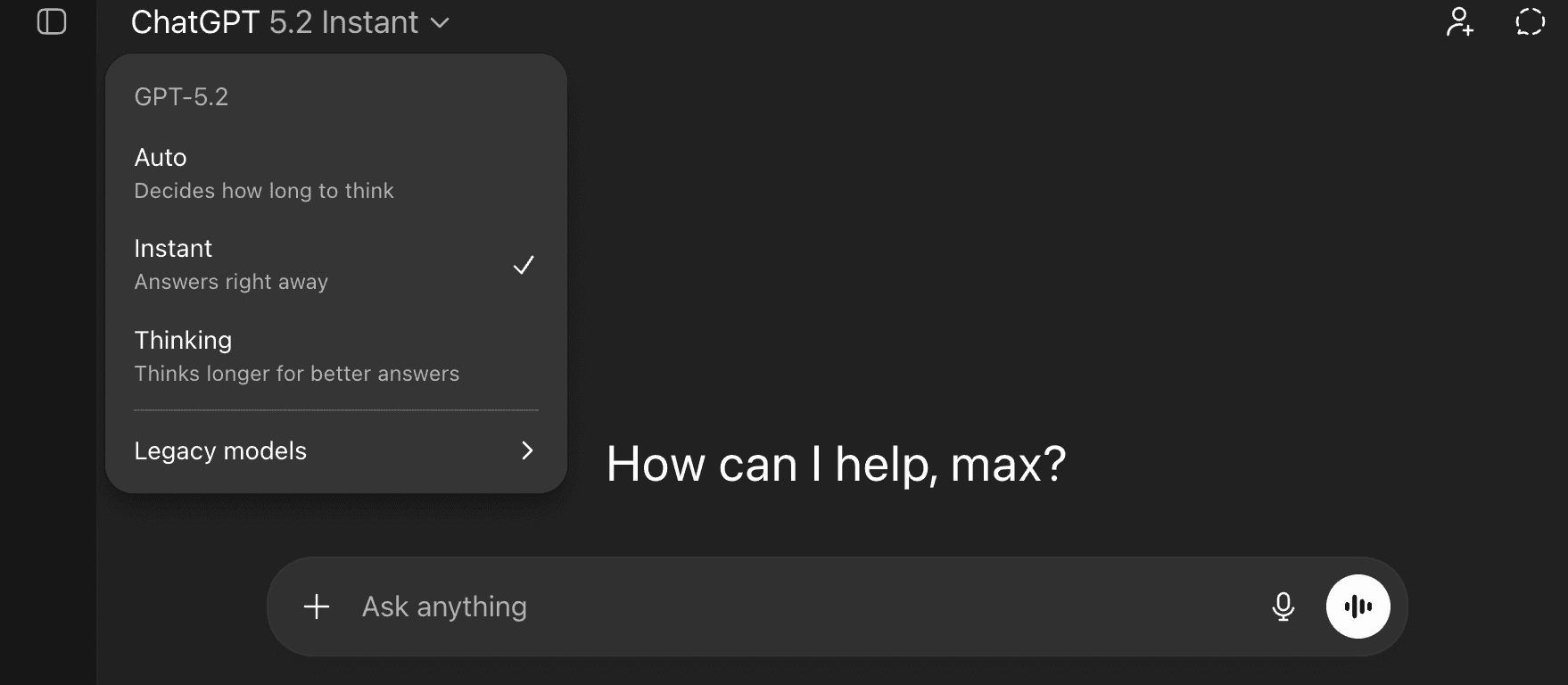
GPT-5.2 introduces three distinct variants, each designed for different use cases:
Instant, optimised for speed and lightweight queries
Thinking, designed for deeper reasoning and multi-step analysis
Pro, the most capable variant for complex, high-stakes workflows
Alongside these variants, several core improvements are particularly relevant to GEO.
Improved factuality
GPT-5.2 hallucinates less than previous models. OpenAI claims response errors are around 30 percent less common, increasing confidence in factual outputs.
For eCommerce, this raises the bar. Models are less likely to invent product details or retailer claims, and more likely to rely on well-structured, consistent, and corroborated sources.
Long-context understanding
GPT-5.2 supports a 400k token context window, with near-perfect accuracy reported up to 256k tokens.
This allows the model to process long-form content such as product catalogues, comparison guides, technical specifications, policy pages, and extensive review data.
Brands with fragmented or inconsistent information are more likely to be filtered out in favour of clearer, better-structured sources.
Vision and multimodal reasoning
GPT-5.2 shows significantly improved image understanding. It can interpret visuals, charts, diagrams, and layouts with lower error rates and a stronger grasp of spatial relationships.
This has growing implications for eCommerce as models become better at interpreting product imagery, packaging, visual instructions, and comparison graphics alongside text.
These improvements will directly influence how ChatGPT evaluates products, selects sources, and references brands in its responses. The shift from GPT-5.1 to GPT-5.2 introduces new expectations around clarity, structure, and credibility. For brands, this means rethinking how content is created, organised, and validated across the entire customer journey. Below are our most practical and impactful steps to help your brand stay visible and competitive in GPT-5.2.
7 Practical steps to optimise your visibility in GPT-5.2
1. Consolidate product truth into a single, authoritative source
Why this matters more in GPT-5.2
With a 400k token context window and stronger cross-document reasoning, GPT-5.2 is far better at detecting inconsistencies between:
Product pages
Help centres
FAQs
Blog content
Third-party listings
If your sizing, materials, pricing logic, or product claims differ across pages, GPT-5.2 is more likely to discard your brand entirely rather than guess.
Practical actions
Create a single “source of truth” for each product or product line
Ensure specs, features, and benefits are identical across PDPs, FAQs, and support documentation
Regularly audit third-party marketplaces and affiliates for outdated or incorrect descriptions
2. Write for comparison, not just conversion
Why this matters more in GPT-5.2
GPT-5.2 excels at multi-step reasoning, handling prompts such as “Compare X vs Y”, “Which is better for…?”, and “Best option if…”. Brands that clearly explain trade-offs are more likely to be referenced.
Practical actions
Add explicit “Who this is for / who it’s not for” sections
Publish honest comparison pages, including against competitors where appropriate
Include decision-making criteria such as durability, budget, use case, and experience level
Models trust brands that acknowledge limitations. GPT-5.2 rewards transparency and factually accurate claims.
3. Structure content for long-context understanding
Why this matters more in GPT-5.2
With near-perfect accuracy reported across very long inputs, GPT-5.2 can process buying guides, category pages, and policy documents in full. Poor structure now actively reduces clarity.
Practical actions
Use clear, consistent H2 and H3 hierarchies
Avoid burying key information inside marketing copy
Add summary tables for specifications, variants, and pricing tiers
Keep terminology consistent across long-form content
4. Make your brand citable, not just searchable
Why this matters more in GPT-5.2
Lower hallucination rates mean GPT-5.2 prefers sources it can explicitly attribute. Vague claims such as “best quality” or “industry-leading” are less likely to be surfaced.
Practical actions
Support claims with numbers, standards, or recognised certifications
Reference third-party validation such as awards, test results, or press coverage
Use precise language that can be safely paraphrased
If a model cannot restate a claim without risk, it will not mention it.
5. Invest in visual clarity, not just aesthetics
Why this matters more in GPT-5.2
Improved vision and multimodal reasoning mean GPT-5.2 can now reliably interpret:
Product imagery
Comparison charts
Diagrams and instructions
Video content, including YouTube explainers and reviews
Early indications suggest that GPT-5.2’s enhanced vision capabilities are already influencing the types of sources it prefers to cite, with a noticeable shift towards multi modal content, particularly YouTube.
For example, when testing the query “best long distance running shoes” across GPT-5.1 and GPT-5.2, we observed a clear discrepancy in the sources referenced.
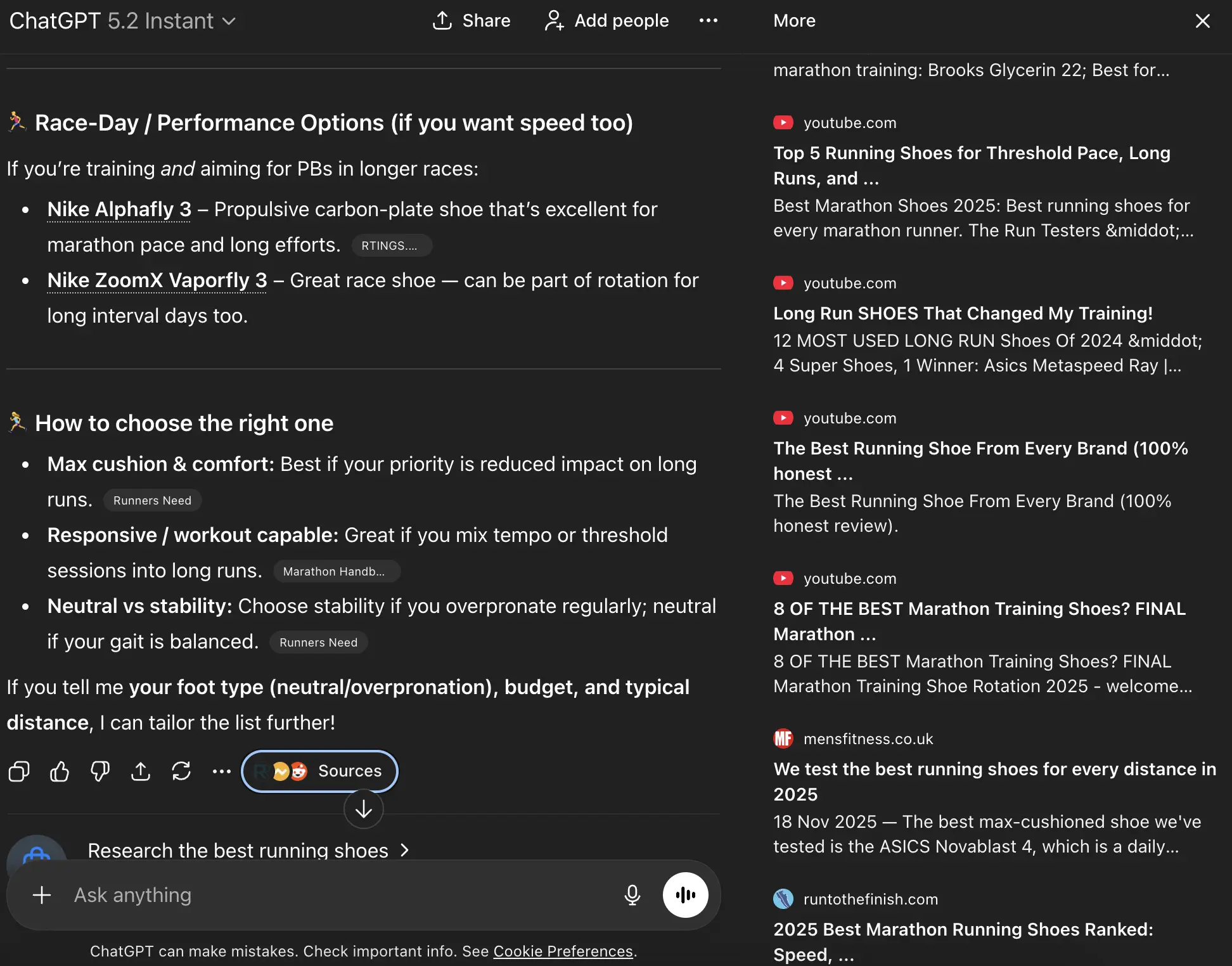
In GPT-5.2, the model cited four separate YouTube videos, indicating a stronger reliance on video based content when surfacing product recommendations. By contrast, GPT-5.1 referenced only a single YouTube source and leaned more heavily on traditional text based articles.
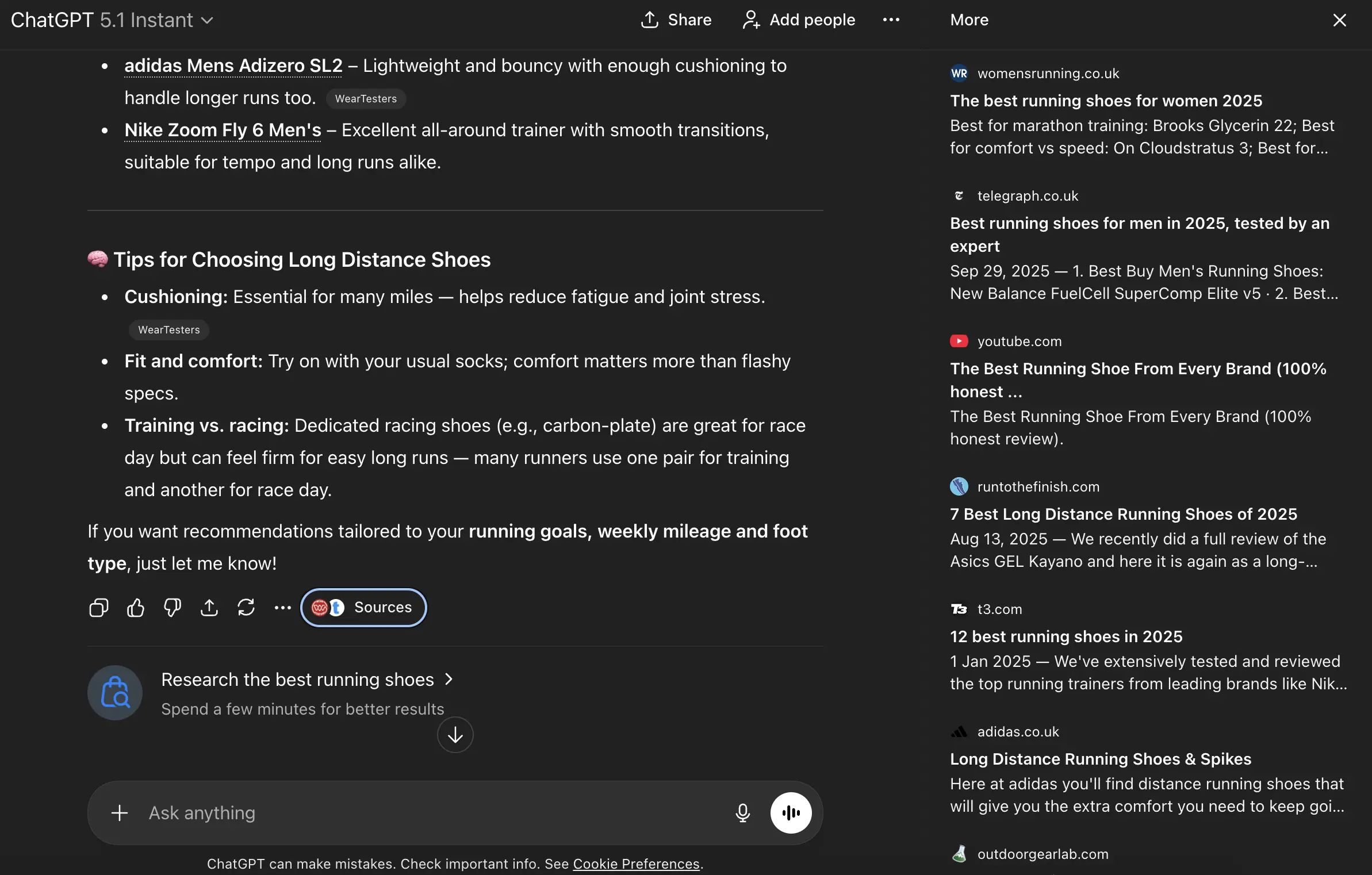
While we are still in the early stages of understanding how GPT-5.2 behaves at scale, these initial results point to a meaningful shift. Video content, and YouTube in particular, is likely to play a more prominent role in how products are discovered and recommended inside generative models.
Practical actions
Use clean, well-lit, consistently framed product imagery
Clearly label images and diagrams (variants, sizes, materials, use cases)
Add simple visual comparisons between products or variants
Publish clear, descriptive YouTube videos (e.g. “How it fits”, “Who it’s for”, “X vs Y”) with accurate titles and chapters
Partner with well-known industry Youtube content creators to feature & promote your product.
6. Push for UGC reviews that give specific feedback
Why this matters more in GPT-5.2
GPT-5.2 places greater weight on concrete, experience-based signals. Generic praise provides little value compared to detailed, contextual feedback.
A review saying “These trainers are great” adds little insight. A review saying “These trainers were great for long walks and standing all day, but felt tight around the toes” gives the model something it can reuse confidently.
Practical actions
Prompt customers to mention use case, context, and trade-offs
e.g. “What did you use this for?”, “How did it perform over time?”
Encourage specificity in reviews and post-purchase emails
Highlight detailed reviews on PDPs, not just star ratings
Encourage video UGC, particularly on YouTube and TikTok, where users explain why something worked
Avoid over-moderating reviews - balanced feedback builds trust
7. Track citation sources with a purpose-built eCommerce GEO tool like Azoma
Why this matters more in GPT-5.2
As GPT-5.2 becomes more selective about attribution, brands need visibility into where and how they are being cited inside generative answers.
Practical actions
Use purpose-built eCommerce GEO tools, such as Azoma, to track citations
Monitor which products, pages, and assets are referenced most often
Analyse competitor citations in comparison and recommendation queries
Use these insights to identify where your brand is losing out to competitors
As generative discovery replaces traditional rankings, measuring GEO becomes as essential as measuring SEO once was. Book a call with Azoma today to learn more about how you can can track and optimise visibility in GPT 5.2.
Summing Up
GPT-5.2 marks a clear shift in how ChatGPT evaluates and recommends brands.
As the model becomes more accurate and more selective, visibility increasingly comes down to clarity and trust. Brands that present consistent product information, explain trade offs honestly, invest in strong visuals, and surface detailed customer feedback are more likely to be referenced than those relying on broad marketing claims or fragmented content.
The early signals point in one direction. Generative discovery is accelerating, video and visual content are playing a bigger role, and GPT-5.2 is raising the standard for what gets cited.
For eCommerce brands, Generative Engine Optimisation is quickly becoming part of the fundamentals. Brands that adapt their content and measurement strategies now will be better positioned as GPT-5.2 becomes the default experience for millions of users.
If you'd like to learn more about optimising & tracking you brand's presence in GPT 5.2, get in touch with Azoma for a call.

Article Author: Max Sinclair