
The shopping cart looks to be coming to ChatGPT: What it means for online sellers
Last Updated:

The launch of the agentic commerce protocol marked the first real example of a third-party marketplace with a merchant-of-record style checkout embedded directly inside an AI interface. It was a meaningful step forward, but one with clear limitations. Today, most agent-driven purchases still follow single-item flows, closer to an intelligent “buy now” action than a fully fledged shopping experience. Now, OpenAI appears to be taking the next big leap.
According to TestingCatalog, a beta feature tracker for LLM products, at least one user has reported seeing a dedicated cart interface inside ChatGPT.
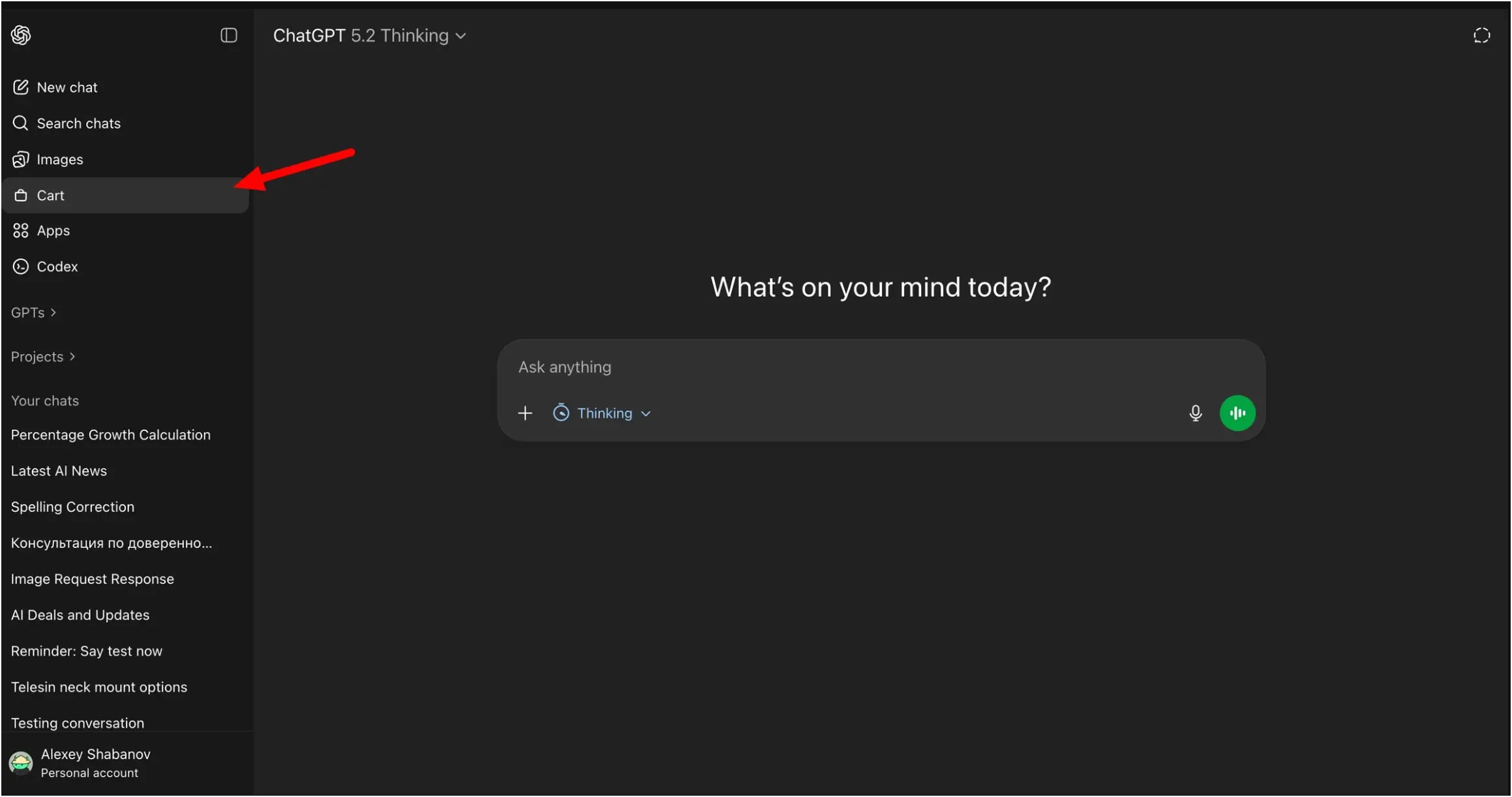
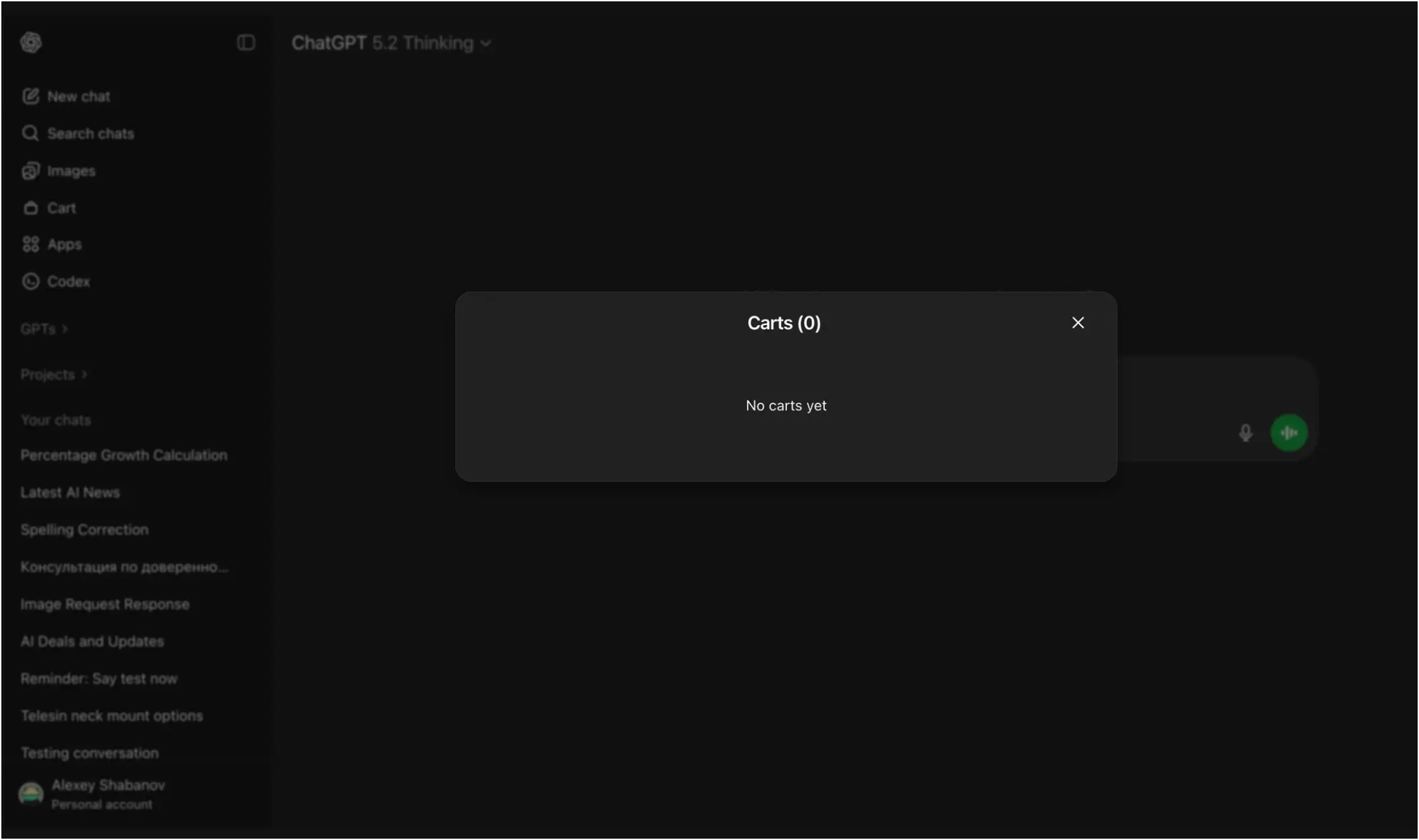
The screenshot above shows a dedicated “Cart” tab in the ChatGPT menu, while the expanded view below reveals a “Carts” page. Together, these suggest support for multiple persistent carts, potentially organised by conversation or use case. While nothing has been formally announced, the presence of this interface points to a native, universal shopping cart, with significant implications for how commerce could function inside ChatGPT.
What a universal cart inside ChatGPT enables
Based on the reported interface, the cart appears to support several behaviours that current agentic flows do not.
First, persistence. Items added to the cart remain there across sessions, allowing users to build towards a purchase over time rather than committing immediately. This mirrors how people already shop online, where intent often develops gradually.
Second, aggregation across merchants. Instead of checking out from a single site at a time, users could potentially add items from multiple retailers into one cart and complete a single checkout. This is a fundamental break from how ecommerce has worked for decades, where each merchant owns the full funnel.
Third, multiple carts for different needs. Users could create distinct carts for specific purposes, such as Christmas gifts, weekly food shopping, or clothing. This turns the cart into an organisational layer, not just a transactional one.
Together, these features move ChatGPT closer to being a shopping operating system rather than a recommendation engine that occasionally completes a purchase.
Why single-item agentic commerce was always limited
Agentic commerce in its current form has had a structural weakness. Most agent purchases are single items, triggered by a specific prompt. That works well for simple, high-intent purchases, but it limits order size and merchant upside.
For decades, online retailers have used the cart as a place to increase average order value. Bundling, cross-selling, and “you might also need” logic all depend on the cart being a shared space where multiple items coexist before checkout. Remove that, and you remove one of the main levers of ecommerce profitability.
A universal cart inside ChatGPT changes this dynamic. Instead of each merchant fighting to maximise value within their own isolated checkout, the aggregation happens at the platform level. Users can build large, multi-merchant carts naturally as they browse, ask questions, and refine decisions through conversation.
From a merchant perspective, this could mean higher order values without needing to redesign their own checkout or recommendation flows. From a consumer perspective, it reduces friction and decision fatigue, especially for complex or multi-step shopping tasks.
Multi-merchant checkout and consumer value
The ability to check out with items from multiple merchants at once is especially powerful. It addresses a long-standing pain point in online shopping: fragmentation.
Buying ingredients for a dinner party, for example, often means jumping between supermarkets, specialist retailers, and last-minute top-ups. The same applies to gifting, home projects, or travel gear. A single cart that spans merchants removes repetitive checkout steps, duplicated address entry, and payment friction.
More importantly, it changes user behaviour. Instead of thinking in terms of stores, users think in terms of outcomes. The agent becomes responsible for sourcing the best options and the cart becomes the place where those options accumulate.
This is where adoption could accelerate. Once users trust ChatGPT not just to recommend products but to manage a full shopping journey end to end, buying inside the interface starts to feel like the default rather than an experiment.
How sellers can prepare for this new reality
If ChatGPT evolves into a place where users build persistent, multi-merchant carts, sellers will need to rethink how they show up. It will no longer be enough for products to be recommendable. They must also be immediately purchasable at the moment intent is formed.
The steps below focus on how sellers can prepare for that shift.
1. Adopt the agentic commerce protocol to enable instant checkout
In an environment where agents assemble carts across multiple merchants, checkout capability becomes a hard requirement rather than a nice-to-have.
OpenAI already supports native purchasing through its agentic commerce protocol. Sellers can apply directly through OpenAI or, if you are a Shopify merchant, enable the integration inside your Shopify dashboard.
Apply here:
https://chatgpt.com/merchants
Without this integration, your products may still be referenced, but they will be excluded at the moment of highest intent.
Implement OpenAI product eligibility flags
OpenAI uses explicit eligibility flags to control how products behave inside ChatGPT. These flags do not affect how products appear on your own site or storefront. Instead, they determine whether a product can be surfaced and purchased within ChatGPT’s shopping experience. As part of the data submitted to OpenAI’s merchant product feed, sellers are required to include the attributes below to indicate a product’s eligibility for discovery and checkout.
Attribute | Description |
|---|---|
is_eligible_search | Determines whether a product can appear in ChatGPT search and shopping results |
is_eligible_checkout | Enables direct purchase inside ChatGPT. Requires is_eligible_search=true |
Insight: As carts become persistent, agents will increasingly prefer products that do not introduce dead ends. If a product cannot be purchased when the cart is ready to convert, it becomes a liability in the agent’s decision-making process.
2. Audit product data against OpenAI product feed requirements
Structured product data is a foundational requirement in the era of agentic commerce.
The OpenAI Product Feed Specification relies on clearly defined, structured attributes to retrieve, compare, group, and transact with products inside ChatGPT. The data points below represent the required and recommended fields that underpin ChatGPT’s shopping experience and determine how confidently agents can evaluate your catalogue.
Required and recommended data points for the OpenAI merchant feed
Basic product data
These fields establish the canonical record used by ChatGPT Search and shopping systems.
Product IDs and SKUs
Product titles and descriptions
Product URLs and canonical references
Item information
Used for classification, filtering, and relevance.
Category and taxonomy mapping
Physical attributes such as size, material, and weight
Product type and condition
Media
Visual assets directly influence confidence and selection.
Primary and secondary images
Optional video, rich media, or 3D assets where available
Price and promotions
Powers pricing display, comparisons, and offer logic.
Base price
Promotional or sale pricing
Currency and pricing validity windows
Variants
Allows ChatGPT to group related SKUs correctly.
Parent-child variant relationships
Variant attributes such as size, colour, or format
Fulfilment
Helps agents assess speed, cost, and reliability.
Shipping methods
Shipping costs
Estimated delivery times
Returns
Reduces perceived risk at purchase time.
Return eligibility
Return windows
Refund policies
Reviews and Q&A
Builds trust and answers common objections.
Aggregated rating scores
Review counts
Frequently asked questions and answers
Related products
Enables basket building and substitution.
Commonly bought together items
Alternatives and replacements
Geo tagging
Ensures regional accuracy.
Location-specific pricing
Availability by region
Shipping restrictions
Merchant information
Provides attribution and credibility.
Seller identity
Merchant policies
Storefront references
Actionable steps
Treat the OpenAI product feed as a primary system, not a derivative one
Keep pricing, availability, and identifiers continuously updated
Ensure consistency across your site, product feeds, and third-party platforms
Sellers can already upload product data directly for inclusion in ChatGPT shopping. In this environment, clean and well-structured feeds are no longer a compliance exercise. They are a competitive advantage.
Insight: In an agentic environment, incomplete or inconsistent data is interpreted as uncertainty. Agents resolve that uncertainty by choosing alternatives they can evaluate and transact with more confidently.
More on the current feed specification here:
https://developers.openai.com/commerce/specs/feed
3. Make your brand credible to AI systems
Agents favour brands they can validate across multiple sources.
Credibility is driven by a combination of owned signals, such as your website and documentation, and earned signals, such as third-party references.
Actionable steps:
Publish consistent, high-quality content on owned channels
Add organisational schema markup to your site
Ensure brand information is accurate across major platforms
Build mentions in sources AI systems commonly reference
Monitor where your brand appears and where it does not
Insight: Authority is no longer about raw backlinks. It is about consistency across the sources agents already trust.
4. Make products easy for agents to understand
Agents do not extrapolate well from vague or marketing-led descriptions.
Anything a buyer might ask in a conversation should already be answered in your product data or supporting content.
Actionable steps:
Create complete, standardised specifications for every SKU
Add explicit feature lists and benefit summaries
Build structured FAQ sections
Include certifications, compliance, and safety information
Define outcomes and intended use cases clearly
Insight: The most agent-friendly product pages resemble reference material, not persuasion copy.
5. Add context so agents know when to recommend you
Context allows agents to match products to intent with confidence.
Without clear context, even strong products will lose out to clearer alternatives.
Actionable steps:
Define target user types explicitly
Specify when and where the product should be used
List compatibility details such as devices, sizes, or systems
Clarify exclusions, limitations, and edge cases
Insight: Agents optimise for suitability first. Reducing ambiguity increases selection probability.
6. Prepare for new visibility metrics
Traditional analytics will not fully capture how agents evaluate your brand.
Visibility in agentic commerce happens upstream of clicks.
Actionable steps:
Track brand mentions in AI-generated responses
Monitor inclusion in agent recommendations
Measure visibility across AI platforms and regions
Treat agent visibility as a top-of-funnel metric
Summing Up
A universal cart inside ChatGPT would quietly change how people shop online. Instead of jumping between sites and checkouts, users could move from question to decision to purchase in one place, at their own pace.
As that shift happens, the brands that win will not be the ones with the flashiest checkout or the loudest marketing. They will be the ones agents can understand clearly, validate confidently, and purchase without friction. If a product cannot be confidently added to a cart, it simply stops being considered.
The challenge is that this decision-making happens long before a click or conversion ever shows up in analytics. It is upstream, invisible, and easy to miss.
That is where Azoma fits in. It helps brands see how AI systems actually interpret their products, from data readiness to recommendation context, so they stay visible and purchasable as shopping becomes agent-led. If you're interested in learning more, get in touch with Azoma here for a demo.
The cart may still be evolving, but the direction is already set. Commerce is becoming conversational, and the brands that prepare now will feel that shift as momentum, not disruption.

Article Author: Max Sinclair