
Canadian Tire: Scaling AI Listing Optimization for the Agentic Commerce Era
Last Updated:
Jul 24, 2025

Overview
Canadian Tire is one of Canada's largest retailers, with businesses spanning automotive, hardware, sports, home, and seasonal products. It also owns a portfolio of brands, including MotoMaster.
To prepare for the rise of agentic commerce, Canadian Tire partnered with Azoma to increase AI-driven traffic to its retail site while growing the visibility of its owned brands across LLMs including ChatGPT and Google Gemini.
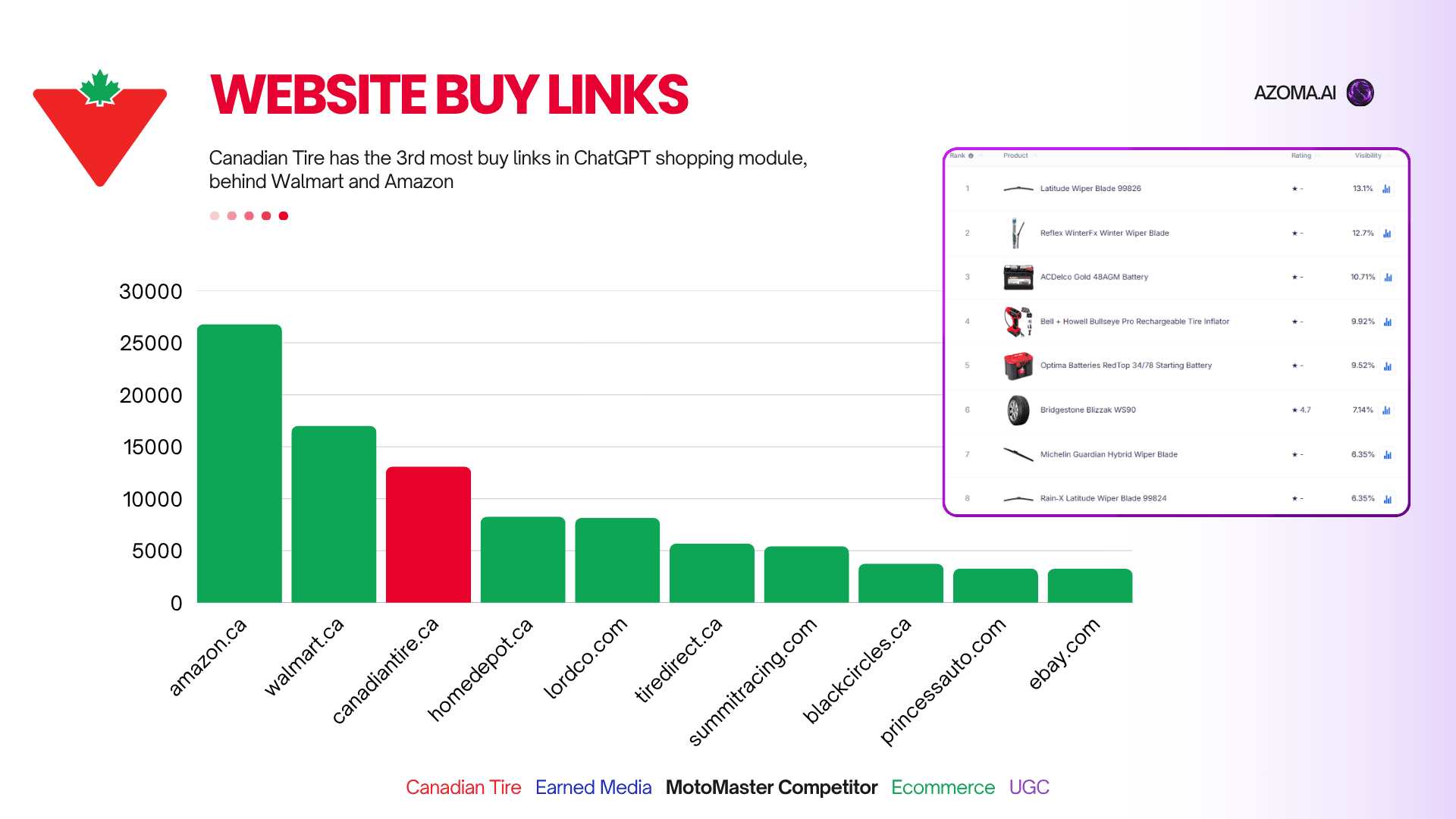
The strategy delivered results on both fronts. Canadian Tire became the third most frequently recommended retailer buy-link in ChatGPT for its categories behind only Amazon and Walmart, while MotoMaster's visibility in AI-generated product recommendations increased from 4.2% to 17.2%.
The Challenge
The way people find and buy products is changing. According to Capgemini, 58% of consumers now use generative AI tools for product discovery, making LLMs like ChatGPT and Google Gemini an increasingly important source of purchase decisions.
When someone asks an LLM for a tire inflator, winter tires, or a cordless drill, the answer is no longer determined by search rankings alone. AI assistants build recommendations from retailer catalogs, product content, reviews, community discussions, editorial content, and other trusted sources across the web.
For Canadian Tire, this created two connected challenges.
Retailer visibility. Increase the likelihood that AI assistants recommend Canadian Tire as the place to buy products.
Brand visibility. Increase the share of voice of owned brands like MotoMaster so they are recommended alongside, and ahead of, competing brands.
The Approach
Azoma addressed both objectives through complementary optimization strategies. One focused on making Canadian Tire's product catalog easier for AI assistants to understand and recommend. The other focused on strengthening the external sources AI assistants rely on when recommending brands.
Retailer Visibility: AI Listing Optimization at Scale
For AI assistants to recommend a retailer, they first need product pages they can confidently understand, compare, and cite. Azoma continuously optimizes Canadian Tire's catalog around the content signals that matter most for AI shopping.
Every month, Azoma generates and continuously improves thousands of optimized product listings across Canadian Tire's site.
To support optimization at catalog scale, Azoma operates directly within Canadian Tire's existing workflows.
Native DAM integration. Azoma connects directly to Canadian Tire's digital asset management system, allowing optimized content and visual assets to flow automatically into existing publishing workflows.
Adopted across teams. More than 40 users across merchandising, ecommerce, and content teams have been onboarded and trained on the platform.
Continuous optimization. Listings are refreshed continuously, keeping pace with new products and evolving AI ranking behavior without manual rework.
Result
Through sustained agentic commerce optimization, Canadian Tire became the third most frequently recommended retailer buy-link in its category across ChatGPT, behind only Amazon and Walmart.
Brand Visibility: Growing MotoMaster's Share of Voice
While listing optimization improved Canadian Tire's visibility as a retailer, increasing MotoMaster's share of voice required influencing the external sources AI assistants rely on when recommending products. In automotive categories, recommendations are heavily shaped by community discussions, editorial buying guides, comparison content, and other authoritative sources across the web.
To strengthen MotoMaster's presence in AI-generated recommendations, Azoma combined several complementary strategies.
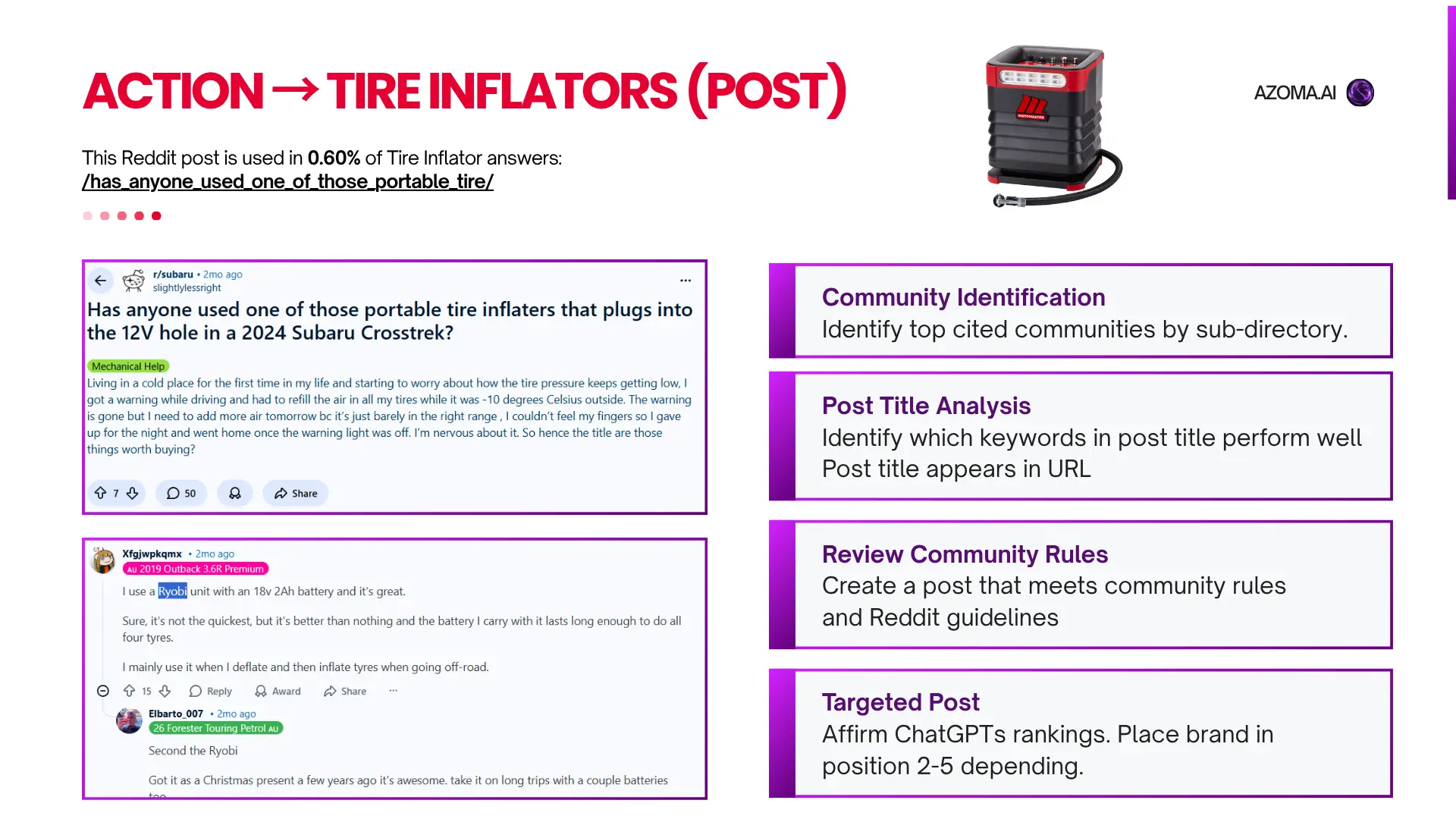
Citation mapping. Azoma identified the specific communities, publications, and individual discussion threads that contributed most heavily to AI-generated recommendations. In some cases, a single Reddit thread influenced a meaningful share of responses. One discussion in r/tires, for example, appeared in 1.31% of AI answers about tire inflators.
Opportunity qualification. Every recommendation opportunity was evaluated against two criteria before a brand was introduced. First, was the user genuinely asking for a recommendation? Second, was MotoMaster an appropriate solution for that situation? Only opportunities meeting both conditions were pursued, ensuring recommendations remained relevant and credible.
Editorial roundup content. Azoma also generated highly citable comparison guides and roundup articles designed around the questions shoppers ask AI assistants, such as "Best tire inflators" or "Best cordless drills." These articles compared products using structured data, clear recommendations, and supporting evidence, giving AI assistants additional authoritative sources that reinforced MotoMaster in product recommendation queries.
Ranking analysis. Azoma analyzed which topics, article structures, and discussion titles most strongly influenced AI-generated recommendations, then continuously refined content to maximize visibility for high-intent shopping searches.
Result
MotoMaster's visibility in AI-generated product recommendations increased from 4.2% to 17.2%, roughly quadrupling how often the brand was recommended by name across leading AI assistants.
Ready for Agentic Checkout
The next evolution of AI commerce is transactional rather than informational. Instead of simply recommending products, AI assistants are beginning to complete purchases on behalf of shoppers.
Two emerging standards are shaping that future.
Universal Commerce Protocol (UCP), led by Google, provides a standardized, machine-readable framework that helps AI systems understand product catalogs, pricing, and availability across retailers.
Agentic Commerce Protocol (ACP), developed by OpenAI and Stripe, enables AI agents like ChatGPT to interact directly with merchant systems to coordinate product discovery, pricing, and checkout.
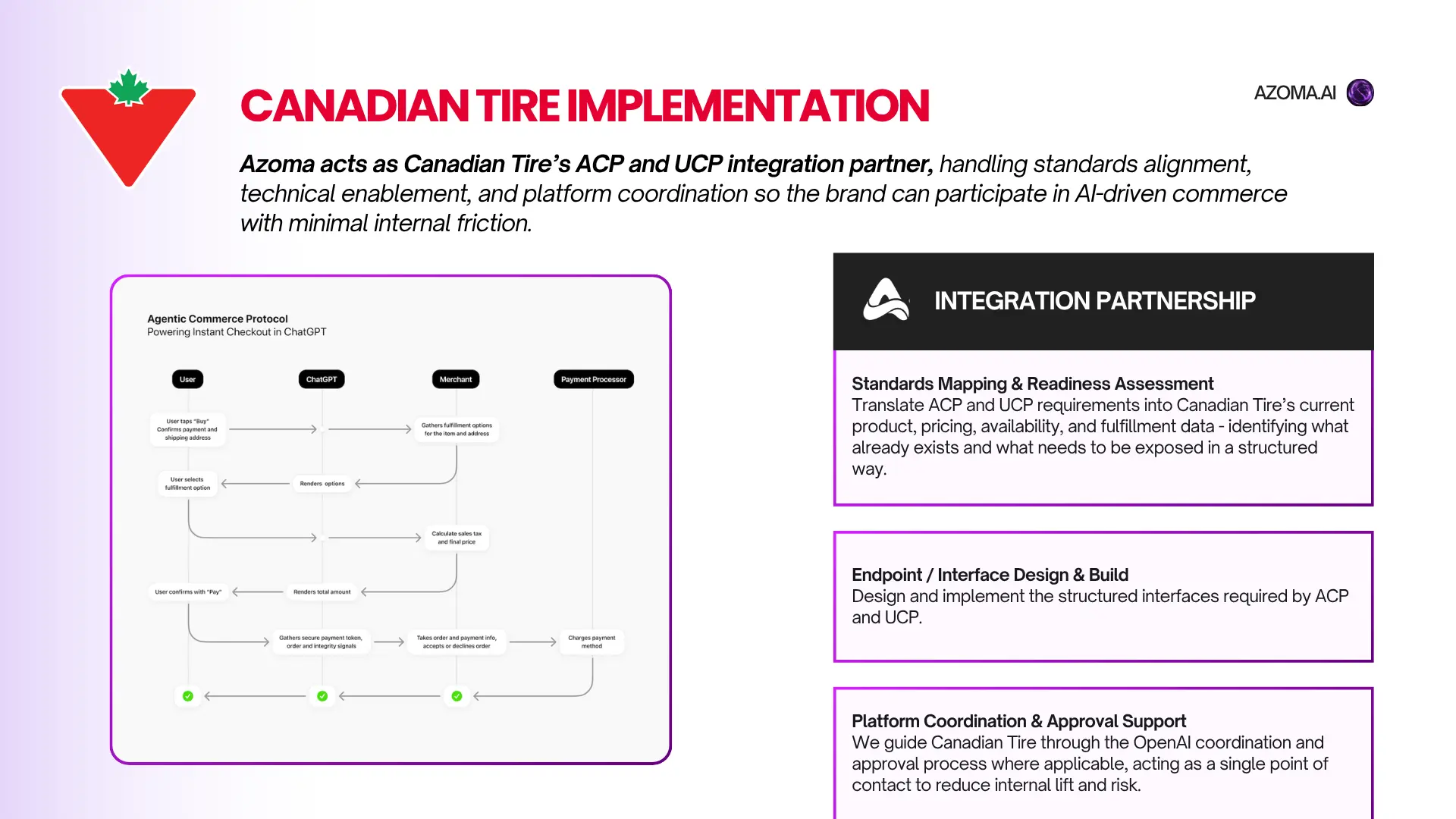
Azoma prepared Canadian Tire's catalog for both standards by structuring product data so it was discoverable, comparable, and transaction-ready. As retailers like Walmart, Target, and Home Depot adopt these protocols, having machine-readable catalog data will become a competitive advantage as AI platforms move from recommending products to completing purchases.
Why It Matters
Agentic commerce creates two distinct opportunities for retailers: becoming the retailer AI assistants recommend and ensuring owned brands are the products they recommend.
By combining continuous catalog optimization with strategic citation development, Canadian Tire achieved both. It increased AI-driven acquisition as a retailer while significantly growing MotoMaster's visibility across AI-generated shopping recommendations.
With an optimized catalog, stronger AI citations, and infrastructure aligned to emerging commerce protocols, Canadian Tire is well positioned for the next generation of AI-powered shopping.

Article Author: Max Sinclair
About the Author: Max Sinclair is co-founder & CEO of Azoma. Prior to founding Azoma, he spent six years at Amazon, where he owned the customer browse and catalog experience for the launch of Amazon in Singapore, the rollout of Amazon Grocery across the EU. Max is also host of the New Frontier Podcast, and is an international speaker on AI and e-commerce innovation.
Lead the AI shift. Or lose to it
Take it to the next level
Take control of your workflows, automate tasks, and unlock your business’s full potential with our intuitive platform.