

Meta is actively building a shopping experience directly into Meta AI on the web. What began as investor commentary about “agentic shopping tools” is now surfacing in live product tests in the United States, according to TestingCatalog.
This is not just a chatbot with product links. It is the early infrastructure for AI mediated commerce inside Meta’s ecosystem.
What Meta is building

Recent builds of the Meta AI website show a dedicated shopping option for US users. When a user enters a shopping related prompt, the assistant:
Detects commercial intent
Initiates a product search
Displays a real time “thinking” phase
Returns results as a carousel of product cards
Each card includes imagery and core details. Clicking a product opens a side panel with expanded descriptions, images, and what appear to be quick purchase options. The final buy button and checkout flow remain restricted in the current build, but the structure clearly points toward deeper transaction integration.
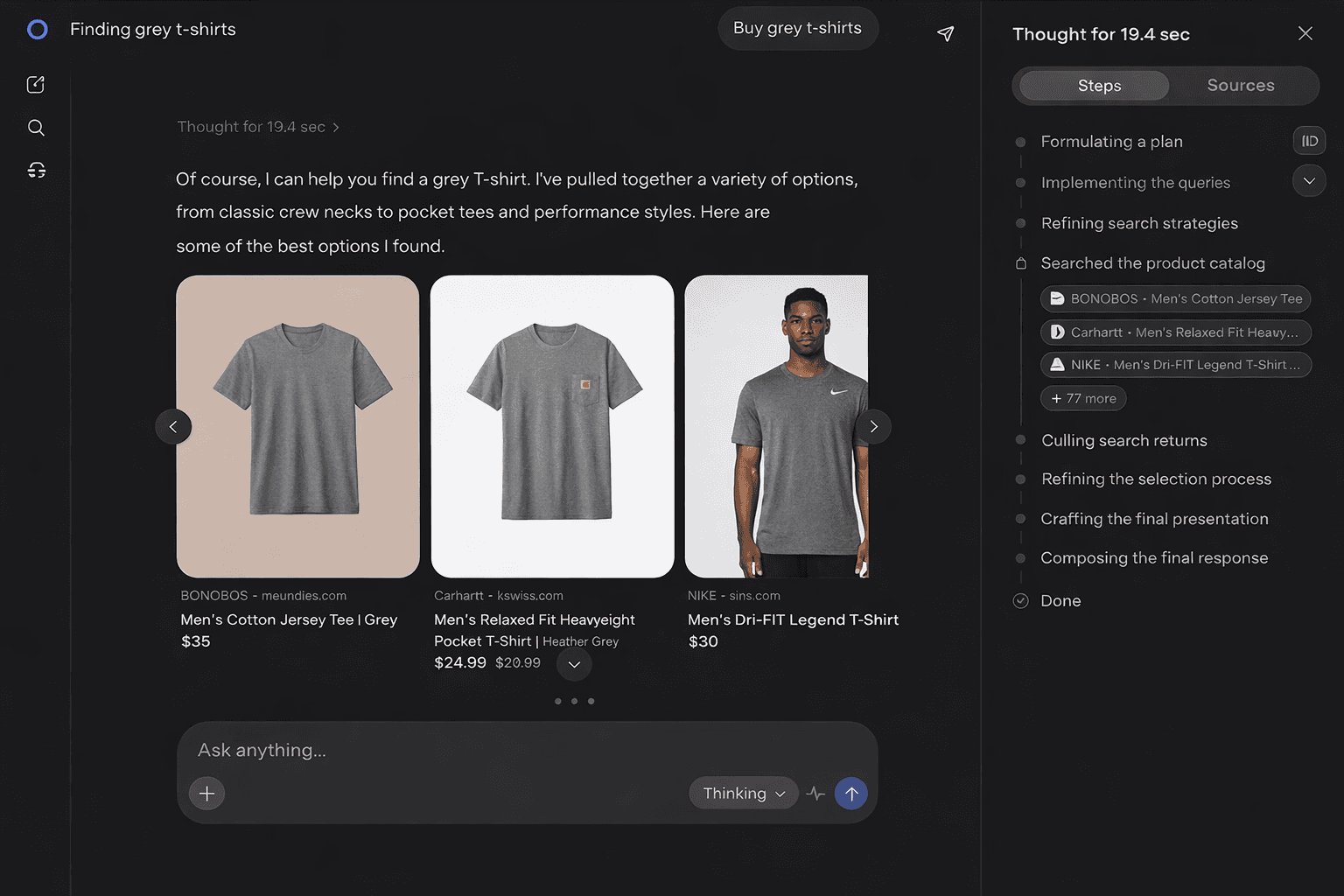
Under the hood, Meta AI appears to query Meta’s product catalogue and reason about categorisation. In some cases, duplicate listings surface, suggesting canonicalisation is still early. But the direction is clear. Meta is connecting conversational AI directly to its commerce graph.
The strategic context: Manus and Avocado
This rollout is happening alongside two major AI developments inside Meta.
First, Meta recently acquired Manus, an autonomous AI agent technology company. The goal is to accelerate conversational platforms and strengthen social commerce. Agentic shopping inside Meta AI looks like a practical use case for that capability.
Second, Meta is building a next generation large language model internally, codenamed Avocado. Expected in the first half of 2026, Avocado is designed to improve reasoning and coding capabilities and may represent a shift toward a more proprietary model strategy.
There are also indications that some Meta AI search queries are currently routed through Google’s Gemini 3 models internally. Whether shopping will ultimately run entirely on Avocado or as part of a multi model system remains unclear.
What is clear is this: better reasoning models make agentic commerce more powerful. Stronger intent understanding, improved product comparison, and more accurate ranking all depend on model quality. The shopping feature’s evolution is likely tightly linked to Meta’s broader AI model refresh later this year.
What this means for merchants
Structured data becomes a primary growth lever
If Meta AI relies on Meta’s commerce catalogue to evaluate and recommend products, then product data quality directly determines visibility.
Incomplete or inconsistent catalogue feeds will be disadvantaged, regardless of brand strength or ad spend.
Structured data is no longer a backend concern. It is a growth lever.
Product context matters as much as product features
Agentic systems will likely be highly personalised, using Meta’s data to match products to specific needs and constraints.
Merchants need to be explicit about:
Who the product is for
What problem it solves
When it is the right choice
What makes it different from alternatives
Vague positioning that relies on aesthetics or brand halo will struggle in agent mediated flows. Precision helps AI systems match products to specific intent.
Organic social content may influence AI interpretation
Meta controls vast first party social data across Facebook and Instagram.
Given multimodal AI capabilities, it is plausible that:
Product images
Videos
Captions
Engagement signals
could influence how products are interpreted and surfaced.
For merchants, product focused organic content is not just brand marketing. It may become part of how AI systems understand and categorise products.
How merchants can prepare now
Agentic commerce is still emerging, but the direction is clear. Merchants can act today.
1. Audit and improve your Meta catalogue quality
Start with the fundamentals.
Meta AI is pulling from Meta’s commerce infrastructure, which is powered by the Meta Commerce Manager catalogue system. If your product data inside Meta’s shopping catalogue is weak, inconsistent, or incomplete, your visibility inside AI results will suffer.
Ensure your product data is:
Complete
Accurate
Consistently structured
Regularly updated
Focus specifically on:
Clear, descriptive product titles
Detailed attributes and technical specifications
Clean and logical variant structures
Accurate pricing and real time stock levels
High quality, consistent imagery
Meta’s catalogue documentation already outlines the structured fields its systems rely on, including required attributes, category mappings, and feed formatting standards. That documentation is effectively a blueprint for how Meta’s AI understands your products today.
The better your structured data inside Meta’s shopping catalogue, the easier it is for AI systems to:
Interpret your product correctly
Compare it against competitors
Match it to specific user intent
Confidently recommend it
If your catalogue is messy, duplicated, missing attributes, or poorly categorised, fix that now. In agentic commerce, weak data equals weak visibility.
Think of your product feed as infrastructure, not administration.
2. Clarify product positioning and use cases
Agentic systems match intent, not just keywords.
Rework your product descriptions to make use cases explicit and machine readable.
Be precise about:
Target audience
Core benefit
Situational fit
Constraints or limitations
For example, instead of saying:
“Premium skincare for glowing skin”
Say:
“Lightweight, fragrance free moisturiser designed for teenage sensitive skin prone to breakouts.”
The second description gives an AI system:
A demographic signal
A skin type
A problem state
A clear use case
That clarity makes it easier for Meta AI to match your product to queries like:
“Moisturiser for teen with acne prone skin”
“Skincare gift for 16 year old girl with sensitive skin”
Vague positioning that relies on brand equity or aesthetic appeal will underperform in agent mediated environments. Precision wins.
3. Invest in high signal organic content
Meta has a structural advantage over other AI platforms because it controls vast first party social content across Facebook and Instagram.
As multimodal AI systems evolve, product understanding may draw from:
Captions
Images
Videos
Engagement patterns
Contextual usage signals
Create organic content that clearly demonstrates:
Who the product is for
How it is used
Real world results
Specific scenarios
This could include:
Demonstration videos
Contextual lifestyle imagery
Before and after examples
Clear problem solution storytelling
In an agentic world, content does more than persuade people. It may help shape how the system understands your product category, audience, and use case.
High signal, product focused content becomes part of your AI discoverability strategy.
4. Prepare for paid AI mediated placement
It is unlikely that priority placement inside Meta AI recommendations will remain purely organic.
Given Meta’s ad driven business model, expect:
Sponsored placement within AI generated product lists
Premium discovery formats
Agent optimised ad products
Paid prioritisation inside canonical product entities
Merchants should plan for AI mediated distribution as a future acquisition channel, not assume it will be a free layer.
Budget for experimentation early. Treat agentic placement as a strategic test bed rather than a reactive spend category.
Those who learn how ranking and recommendation behave early will have a structural advantage.
5. Start measuring AI visibility
As AI agents intermediate discovery and choice, traditional metrics such as impressions, clicks, and follower counts may become less predictive of performance.
Instead, begin asking:
Are we being recommended for key buying intents?
In what contexts?
Against which competitors?
For which audience types?
Share of voice inside AI environments will become a new competitive metric.
That will require:
Regular testing of prompts inside Meta AI
Monitoring which competitors surface consistently
Identifying gaps in your catalogue data
Auditing how your products are described versus how users actually search
➡️ If you want a first look at how prepared your brand is for Meta’s agentic shopping experience, reach out to Azoma today.
A shift in who controls the buying journey
Meta is aligning:
A conversational assistant
A structured commerce catalogue
A next generation reasoning model in Avocado
Autonomous agent capabilities via Manus
Together, these pieces form the foundation for agentic commerce inside Meta’s ecosystem.
If this trajectory continues, the platform, not the merchant website, increasingly controls how products are discovered, evaluated, and potentially purchased.
Merchants are no longer marketing solely to people. They are also optimising for AI systems that act on people’s behalf.
Agentic commerce is shifting competition from attention to selection. Merchants who improve data quality, clarify positioning, strengthen content, and prepare for AI mediated placement now will be better positioned as this shift accelerates. ➡️ Get in touch with Azoma today, if you want an audit of your agentic commerce readiness.

Article Author: Max Sinclair