
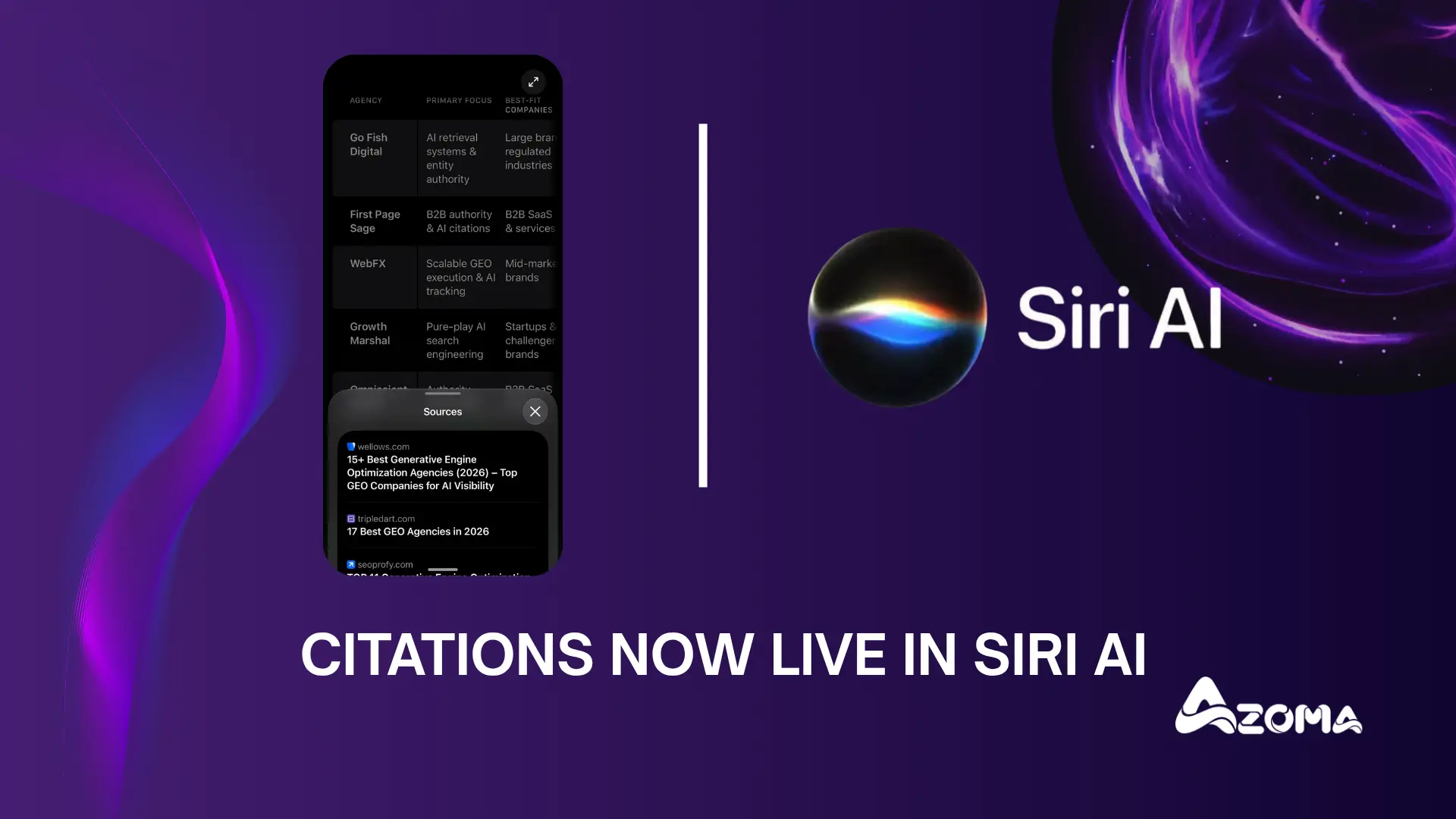
Last month Apple put an AI shopping agent one swipe from the lock screen, on 2 billion devices. The iOS 27 Public Beta introduced Siri AI, and with it a conversational shopping surface that already knows the shopper before the conversation starts.
Conversational shopping used to take a deliberate act: open ChatGPT, Gemini, or Amazon. Siri AI deleted that step. It starts every conversation with context pulled from your mail, calendar, and history, so a generic query becomes a personal one. That is the part rivals cannot easily copy, and it is what turns a novelty into a daily habit.
That changes the job for brands. Siri now recommends products, and like every other shopping agent, it builds those recommendations from sources. Siri now has citations, and citations are something you can influence.
Where Siri's recommendations come from
Siri does not hold its own product knowledge. Its intelligence runs on a custom version of Gemini, and Gemini synthesises its shopping answers across four source types: retailer listings, earned media, brand.com, and user-generated content. No single field, retailer, or page decides how your brand shows up. AI builds its answer by combining signals across all of them.
This is the third of the 5 Cs of Agentic Commerce: Citations. Completeness makes you eligible to appear. Context makes you the relevant answer. Citations earn you the sources AI actually trusts when it constructs a recommendation.
The citation breakdown we expect for Siri
Because Siri inherits Gemini, our working assumption is that its citation behaviour mirrors Gemini's. Based on Azoma's analysis of shopping agent citations, that breaks down roughly as follows:
Retailer: 41%
Earned media: 37%
Brand.com: 15%
UGC: 7%
This is our assumption, drawn from Gemini's known behaviour rather than direct measurement of Siri in the wild. Siri sits a personal-context layer on top of Gemini, so the live mix may shift as real shopper queries flow through the beta. We are testing it now and will report what we find.
What the split tells us is clear enough to act on. Retailer listings and earned media carry the weight, together accounting for more than three quarters of the sources. If your brand is not present and accurate across those two surfaces, you are not in the conversation Siri is now having with 2 billion shoppers.
That has a direct organisational consequence. Retailer citations are owned by your ecommerce team, and the Completeness, Context, and Correctness work you do on retailer PDPs feeds directly into how you get cited. Earned media is owned by PR and corporate communications. Getting recommended by Siri is a job for those functions together, not your content team alone.
What to do about it
Find out where Siri looks in your category. Citation behaviour shifts by industry. Beauty leans heavily on earned media, food skews toward retailer, and the mix changes again by brand authority. Establish which source types the model actually references for your products before you decide where to invest.
Fix your retailer surfaces first. Retailer is the single largest source. Audit your PDPs across the major platforms for completeness and accuracy, since that work maps straight onto citation performance. Now that Siri acts on a shopper's behalf rather than just suggesting, a wrong price or stale stock status becomes a wrong action taken, not a missed impression.
Bring PR into the agentic commerce conversation. Earned media is the second largest source and sits outside most ecommerce teams' remit. PR teams already hold relationships with the publications AI references most. Task them with pursuing coverage in those titles, and with placing corrective content where AI is repeating an inaccurate brand narrative.
Seed accurate content where communities discuss you. UGC is smaller in the mix, but Reddit, Quora, and review sites still feed the synthesis. Social and community teams should ensure the brand shows up accurately in the forums the model draws from, and every brand should have a Reddit strategy.
Track how Siri recommends you. Personal context means the same query returns different products for different shoppers, so there is no single ranking to check. Monitor how often Siri surfaces your products, against which queries, and where you sit versus competitors, measured across shopper types rather than on average.
Beyond citations: the other levers
Citations decide which sources Siri trusts, but they are not the only thing that determines whether you get recommended. Two further inputs do most of the remaining work, and both map back to the earlier Cs.
Your Google Merchant Center feed (Completeness). Merchant Center is the primary input into Google's Shopping Graph, the layer Gemini draws on for commerce answers. A complete, approved feed means your products are represented accurately in the exact place Siri inherits its product knowledge from. Audit it across title, description, product type, Google product category, GTIN, availability, price, variants, and the category-relevant attributes shoppers actually ask about.
Machine-readable owned content (Context). Attributes describing who and what a product is for, use case, audience, occasion, compatibility, matter most, because those are precisely what Siri's personal context matches against what it already knows about the shopper. Make important pages crawlable, allow legitimate AI and search crawlers, implement product and article schema consistently, and avoid burying core product content behind JavaScript that may not be reliably processed. Schema is no guarantee on its own, but it helps these systems understand page purpose and product detail.
Question mapping for spoken, contextual queries. Siri fields full spoken questions, not keyword fragments, and many arrive with context already built. Pull keyword data filtered for who, what, where, when, why and how, mine People Also Ask boxes, and read how shoppers phrase requests on Reddit and Quora. Then check whether your feed, PDPs, and FAQs actually answer the high-intent questions that matter in your category. Any question that goes unanswered is the first gap to close.
The personal context layer sits on top of all of this and is Apple's alone. Plain Gemini optimisation gets you into the shortlist. Being the specific, obvious fit for a given shopper is what wins the recommendation once personal context does the ranking.
The bottom line
Siri AI is a very large new front door onto Google's existing product knowledge, and it opened just as conversational shopping is getting far more common. Siri now has citations, and the brands it recommends will be the ones cited consistently across the surfaces its model trusts. The two that matter most, retailer and earned media, sit with your ecommerce and PR teams. Aligning them now is the work, and we will keep testing exactly how Siri cites as the beta matures.
👉 Want to know how Siri AI is citing your products? Get in touch today to learn more.

Article Author: Max Sinclair