
Sparky is no longer an app-only experience. Walmart has now rolled its AI shopping assistant out across Walmart.com, putting it in front of every desktop and mobile web shopper rather than just the app audience that has been using it since launch.
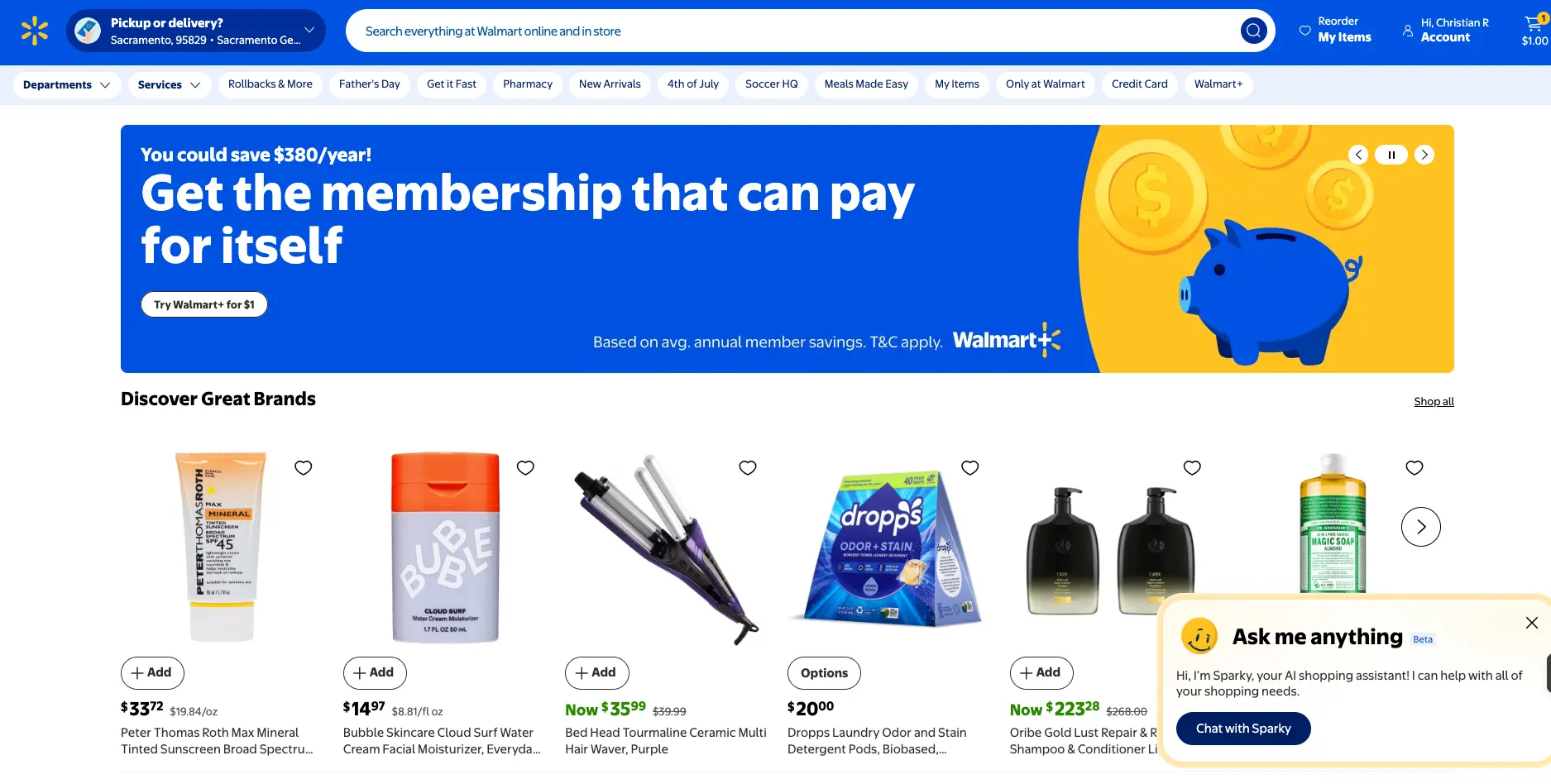
How we got here: Sparky's adoption curve
Sparky launched in June 2025 inside the Walmart app, initially focused on review summaries, recommendations, and purchase planning. Since then it has evolved to include personalised replenishment, meal planning, and smarter recommendations based on inventory, price, and fulfilment speed. Adoption has been strong by any measure:
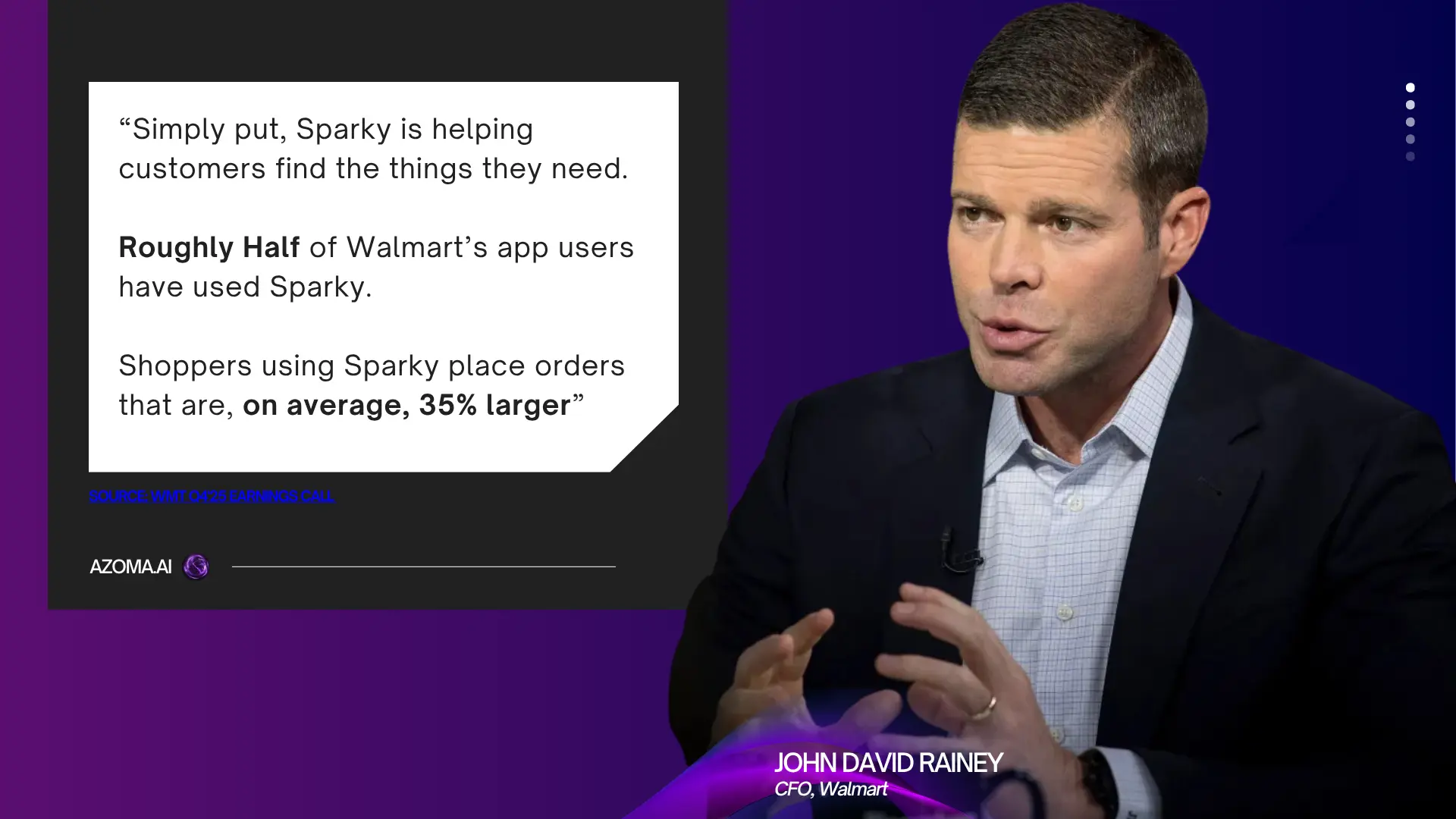
Roughly half of Walmart's app users have tried Sparky, according to Walmart US leadership earlier this year.
Shoppers who engage with AI build baskets around 35% larger than those who don't.
Units purchased through Sparky more than quadrupled quarter over quarter, per Walmart's most recent earnings call, as usage shifted from general merchandise discovery into everyday essentials like food and consumables.
Sparky has expanded beyond Walmart's own surfaces, with an embedded experience inside ChatGPT and a Gemini integration in progress, after Walmart found that shoppers converted far better in its own environment than through OpenAI's in-chat checkout.
All of that happened while Sparky was still confined to the app.
What's new on the website
The headline additions with the web rollout include:
Full assistant access on desktop, bringing the conversational search, planning, and recommendation features that were previously app-only to walmart.com.
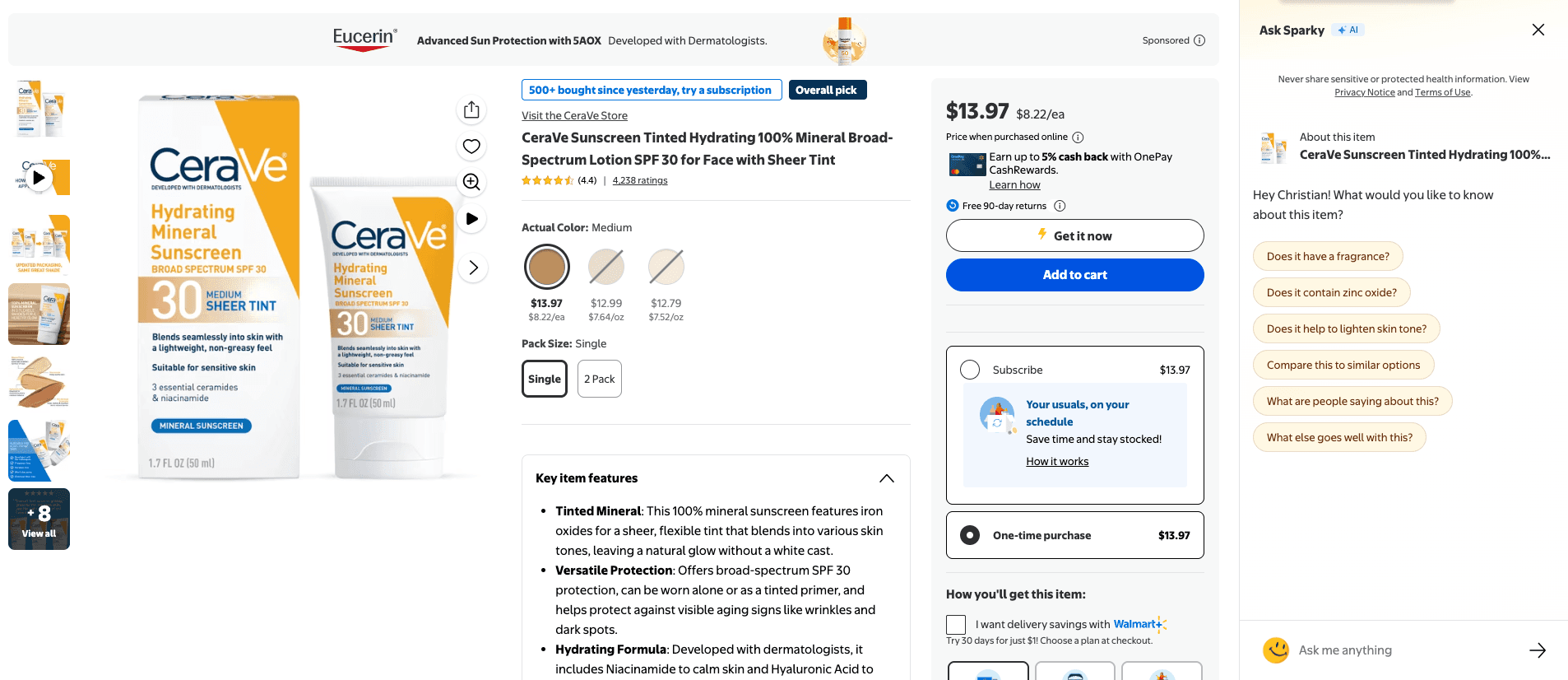
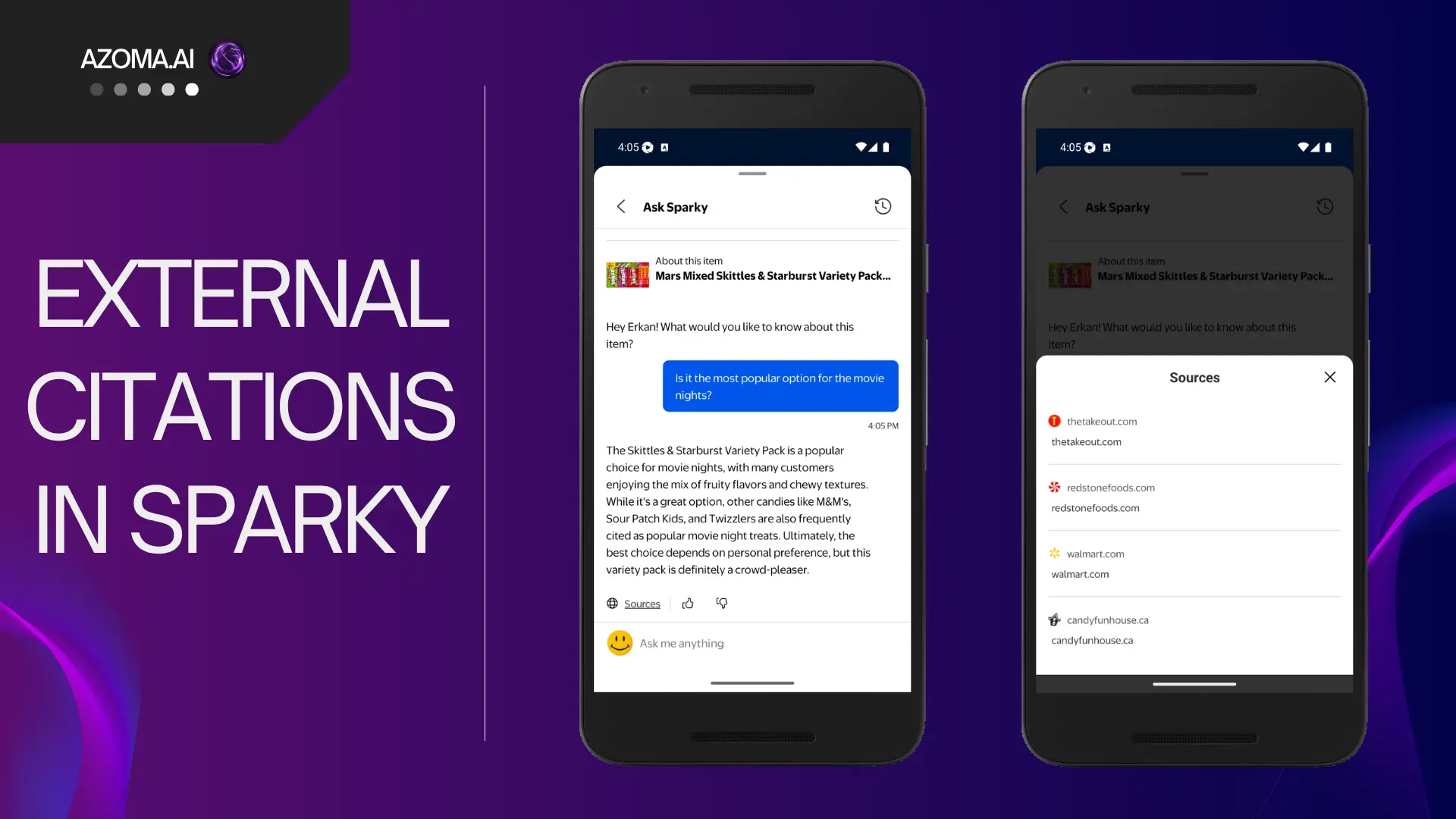
Sparky questions on product pages. Shoppers can now ask Sparky about a specific item directly from the PDP, covering things like suitability, comparisons, ingredients, and use cases.
Why the web rollout matters
The numbers above came from a single surface. Extending Sparky to Walmart.com changes the scale and the trajectory of the agent, in three ways.
1. A step change in adoption. Walmart.com reaches a far broader audience than the app: desktop shoppers, occasional buyers, and the large share of traffic that arrives through search rather than a downloaded app. If half of app users tried Sparky on one surface, exposing it to Walmart's full web traffic puts the assistant on a path to becoming the default way shoppers interact with the catalogue. This tracks with comments from Walmart’s CTO, Hari Vasudev, who said “Walmart envisions Sparky evolving into a truly autonomous shopping agent that can automatically create weekly grocery baskets, analyze photos of customers’ pantries to suggest recipes, and guide complex purchase decisions.”
2. More of the shopping journey runs through AI. The web rollout means discovery, evaluation, and reorder behaviour across Walmart's entire digital footprint can now route through Sparky rather than the traditional search bar. Walmart has been explicit that AI engagement converts into bigger baskets and more frequent trips, which gives it every commercial reason to keep pushing Sparky further into the experience.
3. Sparky is following the Alexa for Shopping playbook. The sequence will look familiar to anyone who watched Amazon build out its AI commerce layer. Rufus started as a contained assistant before expanding across the full site, gradually absorbing more of the shopping journey. Sparky is now tracing the same arc: app first, then site-wide. If Amazon's trajectory is any guide, deeper integration into search and the broader shopping experience follows naturally from there, with Sparky's question prompts, personalisation, and agentic capabilities continuing to expand.
How brands should optimise for Sparky on the web
Sparky has moved from Walmart's app to the full website, putting it in front of a broader and more varied audience than the high-intent in-app shoppers it served before. The core optimisation approach carries over: structured data, content completeness, and third-party citations all apply in the same way. The meaningful new variable is PDP questions, which give brands real-time visibility into what Sparky is being asked across their catalogue. For teams that treat this as a content brief rather than a passive report, it is the most direct input available for understanding and closing the gap between what shoppers ask and what listings actually answer.
The optimisation playbook below is built on the our recently launched 5Cs of Agentic Commerce Framework, developed with the Digital Shelf Institute to help brands prepare for AI shopping agents. Here is how each pillar applies to Sparky across Walmart's website and app.
1. Completeness
Sparky's understanding of your product starts with structured data. On Walmart, that means item setup, categorisation, and attribution: size, count, scent, flavour, ingredient, material, age group, and use case fields. Incomplete attribution is one of the most common reasons a product gets surfaced incorrectly or not at all, and it is also one of the most fixable.
Walmart's Listing Quality Score is the practical diagnostic. Work through the content and discoverability components systematically: item name, key features, description, images, category assignment, product type, required attributes, and variant setup. Pay particular attention to variant linkage, since poorly structured variant groups mean Sparky may surface the wrong size or format in response to a specific shopper query. If your score is weak on any of these dimensions, that is where to start.
2. Context
Previously, the advice for Sparky was to infer shopper questions from indirect signals: review themes, AI-generated review summaries, existing Q&A, and Listing Quality gaps. That guidance still holds, but PDP questions now add a direct layer on top. Brands can see exactly what Sparky is being asked at the point of purchase, in the same way Alexa for Shopping questions became a content roadmap for Amazon sellers.
The practical workflow:
Audit the questions appearing on your PDPs regularly, and group them by theme: pack size and format questions, ingredient and suitability questions, usage and compatibility questions, value and comparison questions.
Cross-reference those themes against your listing content. If shoppers are asking Sparky whether your product is suitable for a specific use case or dietary requirement, that answer needs to be explicit in the title, key features, or description, not buried in a review or absent entirely.
Use Q&A and review themes to catch recurring concerns that do not yet appear as PDP questions but Sparky will inevitably be asked about as usage grows.
A listing that directly answers the questions shoppers ask Sparky is a listing Sparky can confidently recommend.
3. Citations
Just like ChatGPT, Gemini & Alexa for Shopping, Sparky also uses 3rd party sources to form its responses.
However, Sparky's citation behaviour is distinct from the other major shopping agents. Based on Azoma's analysis of millions of shopping agent citations, Sparky's source mix breaks down as follows: 36% earned media, 30% brand.com, 27% retailer content, 5% UGC, and 2% affiliate sites.
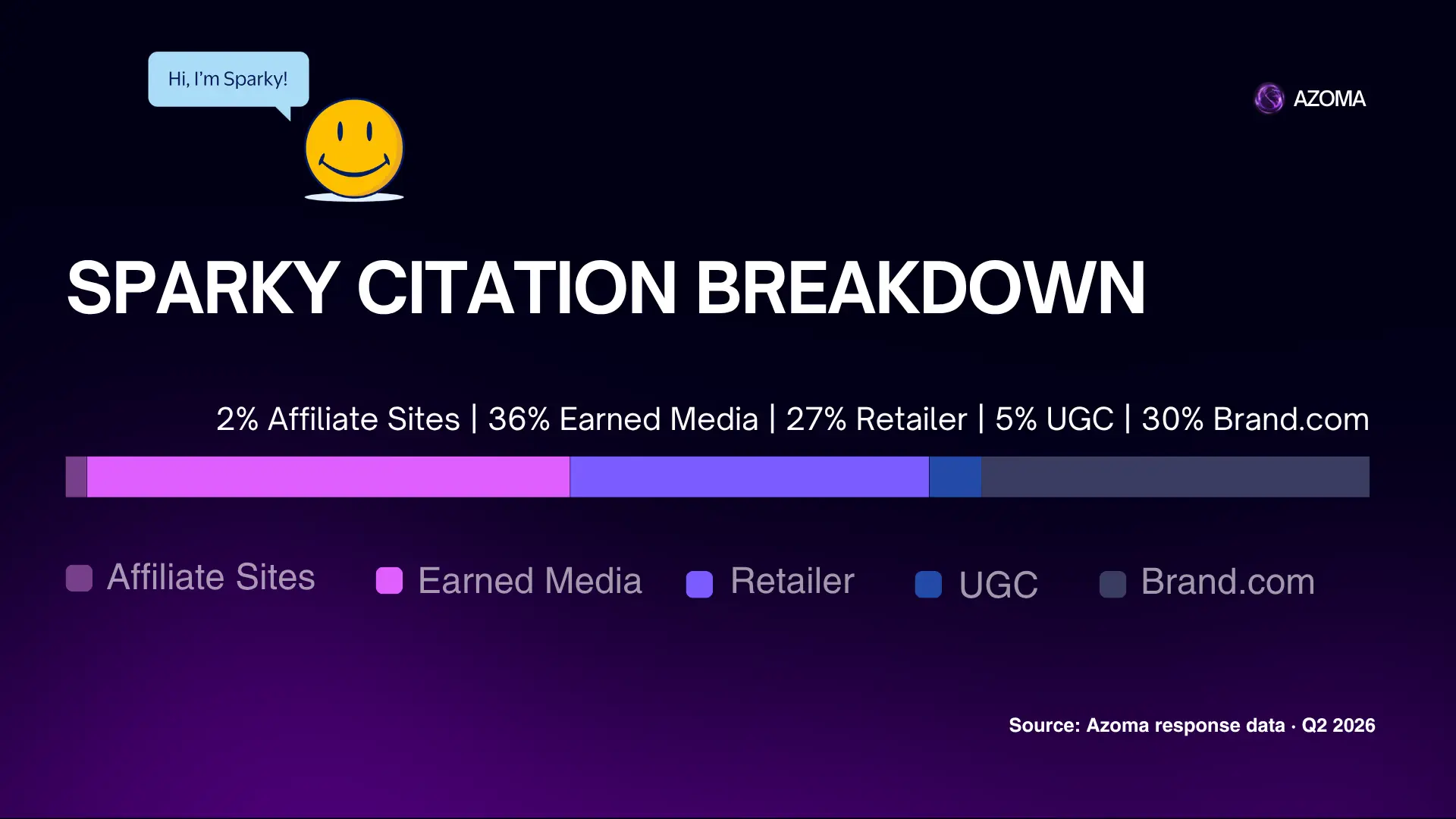
That split has two practical implications. First, retailer content alone is not enough. Unlike Alexa for Shopping, which draws heavily on affiliate and retailer sources, Sparky pulls significantly from brand.com and earned media, meaning a brand that has invested only in its Walmart listing and nothing else is leaving a large share of Sparky's citation surface unaddressed. Second, brand.com matters more here than on most other agents. A well-structured brand website with clear product information, ingredient pages, and use-case content gives Sparky authoritative first-party material to reference when answering shopper questions.
The practical priorities for Citations:
Ensure your brand.com product pages are structured, detailed, and consistent with your Walmart listing. Sparky will cross-reference them.
Invest in earned media coverage in your category: reviews, listicles, and editorial content on trusted publications. These make up the largest single share of Sparky's citations and are where your PR team has a direct role to play.
Monitor UGC sources such as Reddit for recurring questions about your products. Sparky references these at a low but non-trivial rate, and recurring concerns that go unanswered in UGC can surface as negative signals.
Maintain consistency across all surfaces. Sparky synthesises across sources, so conflicting information between your retailer listing, brand.com, and earned media creates ambiguity that tends to resolve against the brand.
4. Correctness
More AI surfaces means more opportunities for AI to get your products wrong. With Sparky now answering questions on every PDP across Walmart's full web traffic, the scale of potential errors grows significantly. Hallucinated specifications, outdated claims, or muddled variant information are direct conversion problems, and ones you will only catch if you are checking outputs systematically rather than spot-checking a handful of hero SKUs.
Build a monitoring cadence that covers your top SKUs by revenue, your highest-traffic PDPs, and any products with complex variant structures or compliance-sensitive claims. When you find errors, the fix is usually upstream: incorrect or missing structured data, thin listing content, or conflicting information across fields that Sparky is trying to reconcile. Correcting the source data is more durable than any other intervention.
5. Customer Acquisition
Tie the work back to commercial outcomes. For Sparky, that means tracking share of voice across the prompts that matter for your category, monitoring item views, impressions, and clicks through Scintilla, Retail Link, Seller Center, and Walmart Connect, and watching rank movement and sales lift against optimised versus control items.
The web rollout also expands the audience worth tracking. App users skewed toward active, high-intent Walmart shoppers. Web traffic includes a broader mix of occasions, including upper-funnel discovery from search and comparison shoppers who may not have an existing Walmart relationship. Winning Sparky recommendations on the web means reaching demand your app presence was not capturing. Walmart's own data shows Sparky users spend more and shop more often, so the brands that show up consistently across Sparky's surfaces are compounding an advantage over those that do not.
The window is open
Alexa for Shopping has years of behavioural data and an intensely competitive optimisation landscape around it. Sparky's website rollout puts it on the same trajectory, but the competitive field is far less crowded. Brands that get their Walmart catalogue, content, and monitoring in order now will hold the same advantage early Amazon SEO adopters built a decade ago.
That is the work Azoma was built for. Our platform audits your catalogue against the questions shoppers are asking AI agents, generates brand-compliant content that closes the gaps at scale, and tracks how Sparky, Alexa for Shopping, and the wider agentic ecosystem represent your products over time. If you want to know where your Walmart catalogue stands before the algorithm matures, get in touch and we'll show you.

Article Author: Max Sinclair