
Amazon Sponsored Prompts: Everything You Need to Know About Amazon's Latest Ad Format
Last Updated:
Amazon just made the biggest change to its advertising platform in years. At the Amazon Ad Summit in Milan, the company announced Sponsored Prompts, a brand new ad format that is already live on the platform and is set to reshape how brands reach shoppers for the next decade.
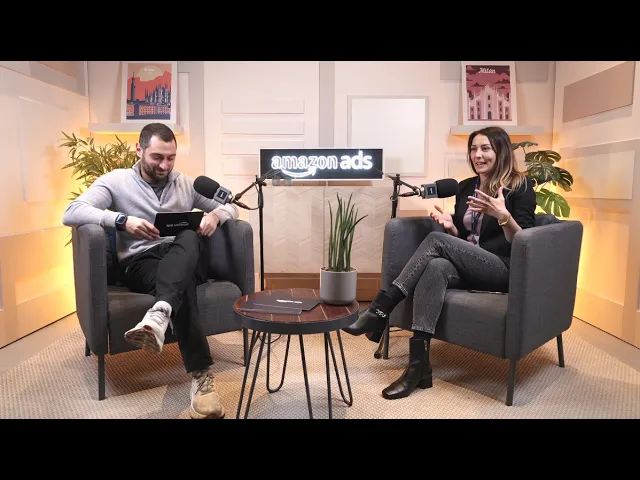
We were in the room with Ali Solomon, Amazon's Global Product Marketing Lead who led the deep dive session on this new format, and the implications for sellers and brands are significant. To watch our discussion, check out the video below:
In this article, we'll cover everything you need to know: what Sponsored Prompts are, how they work, how they differ from Rufus, what you can and cannot control, and what you should be doing right now to prepare for when this becomes a paid product.
What Are Amazon Sponsored Prompts?
Sponsored Prompts are AI-generated follow-up questions that appear underneath Rufus responses on Amazon product detail pages (PDPs). When a shopper interacts with Rufus and gets an answer, they now see a line of suggested prompts below it, clearly labelled as "Sponsored." Tapping one of these prompts opens a conversational response that advocates specifically for the product the shopper is viewing.
The best way to understand the difference between Rufus and Sponsored Prompts is with an analogy All shared during the session. Imagine walking into a department store like Harrods. There are hundreds of vendors, each selling their own products. You approach a floor attendant and ask, "What's the best lipstick for my complexion and budget?" The attendant, who knows the whole store, points you toward a shortlist of suitable options from different brands. That attendant is Rufus.
Now imagine you walk up to the Chanel counter and the Chanel representative starts talking to you about why their lipstick specifically is the right choice for you. They can speak about their own product with authority, highlight its unique features, and answer questions specific to their brand. That second conversation is what Sponsored Prompts enables.
The format is live on Sponsored Products and Sponsored Brands campaigns right now. Brands at the Milan summit were pulling out their phones during the session and seeing the format surface on listings in real time. This is not a future roadmap item. It is deployed, in production, and shoppers are already interacting with it.
Rufus and Sponsored Prompts Are Not the Same System
This is the single most important technical point in the entire announcement, and it is going to be widely misunderstood.
When a shopper taps a Sponsored Prompt, the response opens and displays "Rufus AI (Beta)" in the interface. Visually, it looks identical to Rufus. Functionally and architecturally, it is a completely separate product built by a completely separate team inside Amazon.
Here is how they differ.
Rufus is Amazon's general-purpose shopping assistant. It is trained at the category level and pulls from a broad range of sources including product listings, customer reviews, Q&A sections, and external data. Its job is to give shoppers a balanced, objective view across the entire Amazon catalogue. When a shopper asks Rufus "what's the best noise-cancelling headphone under £300," Rufus is trying to recommend the genuinely best option, not the one that paid the most.
Sponsored Prompts run on a different backend entirely. This model is trained primarily on your own product listing content and your Amazon advertising data. Its job is to advocate for your specific product once a shopper is engaging with your brand. The training data is narrower, the intent is different, and the commercial mechanic is different too.
This distinction matters because it changes how you optimise for each. Rufus optimisation is about category-level relevance, review quality, and external signals. Sponsored Prompt optimisation is about your listing, your advertising structure, and your product-specific positioning. Brands that treat them as the same thing will waste effort.
How the Prompts Get Generated
The prompts that appear under your listings are auto-generated. You cannot write them, edit them, or pick from a list. For now, the system chooses them for you based on several inputs.
Your keyword targeting
The prompts are heavily influenced by the keywords you are targeting inside your campaigns. If you target "noise cancelling headphones for travel," expect the prompts to pick up on travel-related angles.
Your campaign performance
Prompts are more likely to be generated around search terms that are actually driving results. This is particularly true for Sponsored Brands and for phrase and broad match targeting on Sponsored Products, where Amazon has visibility into which customer search terms are converting.
Your placement and context
Where the ad is being shown also influences the prompt. A prompt generated on a category browse page may look different from one generated on a competitor's product page.
The practical implication is that the way you structure your campaigns now has a direct effect on the quality of the prompts customers see. This is not the early days of Amazon advertising, where a bloated campaign with hundreds of loosely grouped keywords could still perform acceptably. In a Sponsored Prompts world, clean, strategic campaign architecture is not a nice-to-have. It is the lever that determines whether your brand shows up with the right question in front of the right shopper.
If you are still running campaign structures designed in 2016 or 2017, with everything dumped into a single ad group, now is the moment to fix that.
You Cannot Edit the Prompts, but You Can Influence the Responses
Here is where things get interesting from a listing optimisation standpoint.
While you cannot currently edit the prompts themselves, you can directly influence the responses that appear when a shopper taps one. Those responses are pulled from your listing content.
Amazon ran tests on this during development. They took a product where a specific feature was being described in a particular way on the listing, observed the response Sponsored Prompts was generating, then rewrote the listing to describe that feature differently. Within approximately one week, the response to the prompt changed to reflect the new listing copy.
That is a significant window, and it is worth understanding why. Amazon's system needs time to re-index your listing, feed the new content through the model, and update the cached responses. It is not instant. If you make a change on Monday, expect the new version to be live around the following Monday.
The takeaway is simple but important. If you look at the prompts appearing on your PDPs and you are not happy with the answers shoppers are seeing, the fix is not in your advertising console. The fix is in your listing. That might mean rewriting bullets to emphasise features that are getting lost, adding specificity around materials or dimensions, or reframing how you talk about benefits. Whatever the issue, the solution is editorial, not paid.
Why Listing Optimisation Has Never Mattered More
For years, listing optimisation has been treated as a launch task. You write your title, five bullets, A+ content, and description at launch, maybe run a refresh annually, and otherwise leave it alone. That approach is now obsolete.
With Sponsored Prompts pulling directly from your listing to generate AI responses at the moment of purchase intent, your listing copy is your ad creative. Every sentence in your bullets, every claim in your A+ content, every specification in your product details is now being used to generate shopper-facing answers in real time.
This changes the economic calculation around listing investment. A well-written listing used to primarily drive search visibility and conversion rate. Now it drives search visibility, conversion rate, and the quality of every AI-generated response Amazon surfaces about your product. The return on a listing optimisation project has materially increased.
Brands that invest in detailed, accurate, benefit-led listing copy are going to get richer, more persuasive prompt responses. Brands with thin, generic, or keyword-stuffed listings are going to get generic or unhelpful responses, and shoppers will notice the difference. In a world where the AI is speaking on behalf of your brand, your listing becomes the voice it uses.
👉 If optimising your Amazon listings for Rufus & sponsored prompts is a priority for your brand, get in touch with Azoma for a demo of our AI-powered listing optimisation tool.
The Monetisation Timeline
At the time of the announcement, Sponsored Prompts are free. You are getting impressions, clicks, and performance data inside your existing campaigns at no additional cost. Amazon has been transparent that the free window exists so they can gather data on how the format influences shopper behaviour before turning it into a paid product.
That window will close. Once Amazon has enough data to prove that Sponsored Prompts are materially changing how shoppers interact with ads, monetisation will follow. The expectation is that brands will be able to bid on specific prompts or prompt types, similar to how keyword bidding works today. At that point, the ability to own the right question at the right moment on a high-intent product page becomes a serious competitive lever.
The smart move right now is to let your campaigns run, monitor the prompts being generated, study the responses, and use that information to refine both your listings and your campaign structure. You are effectively receiving paid market research at no cost. It would be a mistake to switch anything off purely because the new data looks unfamiliar.
One caveat worth noting. When monetisation arrives, brands are almost certainly going to demand the ability to edit prompts directly. If you are paying for a prompt to appear, you want control over what it says. Expect Amazon to ship prompt editing capabilities fairly quickly after monetisation goes live, because the commercial pressure from advertisers will demand it.
What This Means for the Future of Advertising
Here is the bigger picture, and it is worth paying attention to.
Rufus customers are already 60% more likely to convert than non-Rufus customers. In the Q3 earnings call, Andy Jassy credited Rufus with adding $10 billion in additional revenue. Amazon is now integrating Rufus directly into the search bar, which means conversational AI is moving from a feature to the default shopping experience.
The direction is clear. Traditional keyword search, where a shopper types a term and scrolls through ten blue sponsored links, is being phased out. Conversational, AI-guided shopping is being phased in. And where shopper attention goes, advertising formats follow. The prediction from those closest to this launch is that by the end of 2026, the traditional search experience on Amazon will start to look legacy. Sponsored Prompts, or something built directly on top of them, will be the dominant ad format by the end of the decade.
There is a second, broader implication. Amazon has just demonstrated a blueprint for how AI answer engines can be monetised without compromising the user experience. The AI gives the honest, balanced answer first. Then the brand gets to add its voice in a paid follow-up. The shopper is never misled about which recommendation is paid and which is objective, and the commercial model is transparent.
This is a genuinely customer-friendly approach, and it is going to be copied. OpenAI and Perplexity are both searching for ways to monetise their answer engines at scale. Both companies are currently unprofitable and both need advertising revenue to justify their valuations. The Amazon playbook, with answer first and sponsored follow-up second, is almost certainly going to be replicated across every major AI-powered search surface in the next few years.
If you are a brand marketer thinking about how your advertising function needs to evolve over the next five to ten years, Sponsored Prompts is not just an Amazon story. It is a preview of how all generative search advertising is going to work.
What You Should Do Right Now
There are five concrete actions worth taking this week:
Audit your advertising console. Dig into your Sponsored Brands and Sponsored Products campaigns and find the Sponsored Prompt data. It is already there whether you are looking at it or not.
Check the live prompts on your PDPs. Pull up your products on a mobile device, interact with Rufus, and see which sponsored follow-up questions appear. Note the ones that look strong and the ones that look weak or irrelevant.
Read the responses the prompts generate. Are they accurate? Do they reflect your product's actual strengths? Are they persuasive, or are they generic? If the responses are poor, the root cause is in your listing.
Audit your listing copy against what you see. Look for gaps where the AI is missing a key benefit, misrepresenting a feature, or giving a flat answer where there should be a compelling one. Rewrite those sections and track how the responses shift over the following week or two.
Review your campaign structure. If your campaigns are bloated, with too many keywords grouped together and no clear strategic split, now is the time to restructure. Clean, tight, strategically grouped campaigns will generate better prompts than sprawling catch-all ones.
The brands that take Sponsored Prompts seriously now, while the format is free and most competitors are still confused about what it is, will have a meaningful head start when it becomes paid and competitive. Amazon advertising as we knew it changed in Milan. The question is whether you change with it.
➡️ To learn more about optimising your listings for Amazon Rufus, get in touch with Azoma today for a preview of our AI-powered listing optimizer.

Article Author: Max Sinclair