
Tesco Launches AI Shopping: How Grocery Brands Should Optimise for Retailer-Owned AI Assistants
Last Updated:
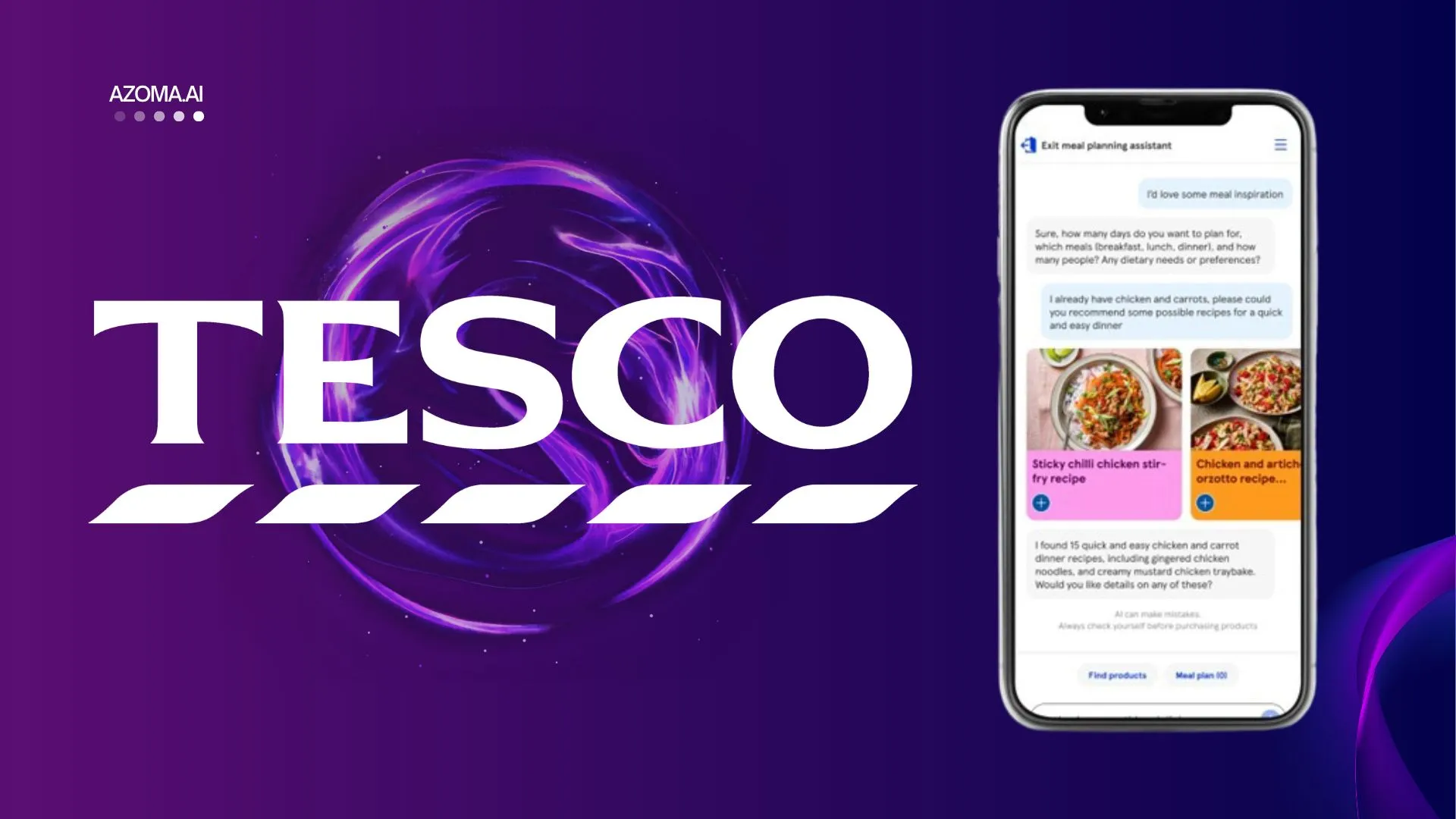
When Tesco's AI assistant rolls out to customers later this year, it will do something no search bar has ever done: it will take a shopper's dietary preferences, purchase history, and what's already in their fridge, and build them a meal plan with a basket attached. Your product either gets included in that recommendation or it doesn't. There is no page two.
Amazon's Rufus, Walmart's Sparky, Target's AI Gift Finder, and a growing wave of equivalents being built by grocers worldwide are all part of this shift. By Black Friday 2025, Amazon Rufus had reached 38% adoption. On that single day, AI chatbots and agents drove $14.2 billion in global sales. Customers who use Rufus are 60% more likely to complete a purchase.
If those numbers felt like a distant American story, they just got a lot closer to home. Just last week, Tesco announced it is trialling a conversational AI assistant embedded directly in its app, with around 280,000 colleagues getting early access ahead of a full customer rollout later this year. Built in partnership with Open AI & Mistral, the assistant currently focuses on meal planning: offering personalised recipe ideas based on dietary preferences and helping shoppers build a basket from those recipes, drawing on their purchase history and stored preferences. Tesco CEO Ken Murphy said the assistant has the potential to "transform the way people shop with us."
For grocery brands, this shift is particularly consequential. Food and household products are precisely the categories where AI excels: high purchase frequency, predictable need states, strong replenishment logic, and a wealth of structured attributes to reason over. Tesco's assistant is already being designed around meal planning and basket building, two of the highest-intent, highest-frequency moments in grocery. The question of which products get surfaced when a shopper asks "what do I need for a healthy family dinner this week?" is becoming as commercially significant as any shelf placement decision.
But here is the uncomfortable truth: most grocery brands are not ready for this. Their PDPs were written for human eyes scrolling a page. Their catalogue data was set up for taxonomy compliance, not semantic understanding. And their off-page presence, the web of content that foundational models train on and ground themselves in, is rarely managed with AI discoverability in mind.
Winning in agentic grocery commerce requires getting three things right: your product detail pages, your retailer catalogue data, and your presence in the external sources that shape the underlying models.
Why Each Retailer's AI Is Different, and Why That Actually Doesn't Matter as Much as You Think
Before diving into strategy, it is worth acknowledging an important reality: every retailer AI assistant is built differently.
Amazon's Rufus sits on top of COSMO, a proprietary commerce knowledge graph, and draws on catalogue data, reviews, Q&A, and external web sources. Walmart's Sparky is built around omnichannel execution signals: availability, substitution logic, and pack economics. Target's AI is distributed across Google and OpenAI via open protocols rather than concentrated in a single assistant. Tesco's incoming assistant is anchored by Clubcard's first-party data and built in collaboration with OpenAI, and Mistral. Every other retailer entering this space is making similar architecture choices of their own.
Despite this diversity, the underlying demands placed on your product content are strikingly consistent. Every AI shopping assistant, regardless of its architecture, needs to do the same things: understand what a product is, determine who it is for, assess whether it fits a shopper's need, compare it against alternatives, and evaluate whether it can be reliably fulfilled. The systems that do this well all converge on the same requirements: clarity, structure, semantic depth, and operational accuracy, across your PDP, your catalogue, and the wider web.
Layer One: The Product Detail Page
The PDP remains the foundational source of truth for every retailer AI system. Whether a human shopper is reading it or an AI agent is parsing it, the PDP is where claims, specifications, benefits, and proof points live. Optimising it for machine comprehension is the starting point for everything else.
1. Build Your Title as a Canonical Object Definition
Your product title is the single most heavily weighted signal in virtually every retailer AI system. It is the anchor point against which all other PDP signals (attributes, bullets, imagery) are validated for consistency. A weak or ambiguous title undermines your entire listing.
For grocery, a strong AI-ready title follows a clear structure:
Brand / Product Type / Key Differentiating Attribute / Size or Format or Count
Examples:
Heinz Classic Tomato Ketchup, No Added Sugar, 700g Squeezy Bottle
Oatly Barista Edition Oat Drink, 1 Litre Ambient Carton
KIND Dark Chocolate Nuts and Sea Salt Protein Bar, 12-Pack
The product type should be the exact category noun the retailer's taxonomy uses, not a brand-invented descriptor. Misalignment between your title's product type and the retailer's taxonomy is one of the most common causes of AI misclassification in grocery.
2. Write Bullets That Connect Features to Outcomes
In an AI-optimised PDP, bullets are inference chains: structured statements that help an AI model reason about why a customer with a specific need would choose your product. The pattern is simple: feature + outcome, written in natural language.
Poor (for AI): "Made with 100% whole grain oats"
Strong (for AI): "Made with 100% whole grain oats for sustained energy release, making it a reliable choice for school mornings or pre-exercise nutrition"
AI systems are building inference models about which products solve which problems. Products that spell out feature-to-outcome connections explicitly score higher on intent matching than products that leave the inference to the model. For grocery specifically, consider the questions your bullets should answer: Is it suitable for children? Can it be used in cooking? Does it work for people managing blood sugar? Is it a good value size for a family?
3. Describe Realistic Usage Scenarios in Long-Form Copy
Where retailers offer a description field or equivalent of Amazon's A+ content, the optimisation goal is semantic depth rather than persuasion. AI systems use this content to build situational understanding of your product: the specific contexts, occasions, and use cases in which it would be appropriate.
Tesco's AI assistant is being built around exactly this type of contextual query. A shopper saying "I want to plan a healthy week of dinners for a family of four" is not making a product search request. They are making a semantic request that the AI must resolve into specific product recommendations. The products that surface will be the ones whose descriptions have given the AI enough contextual depth to confidently include them.
Write descriptions that cover where and when the product is used, who uses it, what problems it addresses, and any seasonal or occasion-based relevance. Avoid pure brand-voice copy as it is largely opaque to semantic parsing. Natural, descriptive language that a knowledgeable sales associate might use performs significantly better.
4. Anticipate and Answer Shopper Questions Explicitly
Every retailer AI assistant is trying to resolve shopper intent. If your PDP does not answer a common question directly, the AI either qualifies the response with uncertainty or selects a competitor product that does answer it.
This matters acutely for Tesco, where the assistant draws on Clubcard purchase history and individual dietary preferences. When a shopper with a known nut allergy asks for dinner ideas, the assistant filters recommendations against both what it knows about the shopper and what the PDP says about the product. Missing or buried allergen information means losing the recommendation for a large and identifiable cohort of shoppers.
Where Q&A sections are available, seed them with the five to ten most common questions in your category, covering dietary suitability, allergens, usage instructions, pack size, and substitution suitability. Where they are not available, weave those answers directly into bullets and descriptions in natural language.
5. Ensure Operational Accuracy and Fulfilment Signals
Every retailer AI system weights fulfilment confidence heavily. Products with unreliable inventory, inconsistent pricing, or vague quantity language are systematically deprioritised by systems that optimise for outcome certainty.
For grocery, this means maintaining accurate stock levels and pricing, providing explicit replenishment signals ("30-day supply for one adult", "serves a family of four for one week"), and stating applicable fulfilment methods clearly for omnichannel retailers.
6. Optimise Visual Content as a Semantic Asset
AI assistants are increasingly multimodal. Rufus reads text overlays on images via OCR and uses them for semantic matching. Target's AI systems parse imagery for meaning. Google's Gemini incorporates visual signals when resolving ambiguity during agentic checkout.
Lead with structural clarity over lifestyle aspiration in your primary image. Use short, factual text callouts on secondary images and treat them as a structured data layer. Write descriptive sentence-style alt text for extended imagery rather than keyword strings. And maintain visual consistency across your range: AI systems surface products as part of coordinated sets more readily when SKUs signal clear membership in a coherent product family.
Layer Two: Retailer Catalogue Optimisation
Most brands treat retailer catalogue setup as a logistics exercise: get the item live, tick the required fields, move on. In an AI-driven retail environment, that approach is a significant competitive disadvantage.
Retailer AI systems do not just read your PDP. They reason over your entire item record. The catalogue is where structured signals live that the PDP never captures, and those signals are increasingly central to how AI assistants classify, rank, and recommend products.
1. Go Beyond Taxonomy Compliance
Taxonomy placement matters, and getting it wrong is costly. Assigning a product to a generic parent node rather than the most specific available category reduces the AI's confidence in what the product is and who it is for. But taxonomy is just the starting point.
The more important question is whether your catalogue record contains the semantic attributes that allow an AI to reason about your product in context. Retailer catalogue systems are expanding their attribute schemas specifically to support AI recommendation logic. Many now accommodate fields that go well beyond traditional classification: preparation method, texture profile, flavour intensity, cuisine affinity, dietary pattern (Mediterranean, plant-based, low-FODMAP), meal occasion, cooking skill level required, and more.
These are not niche fields. They are the attributes that determine whether your product surfaces when a shopper asks Tesco's assistant for "something quick and healthy for a weeknight" or asks Rufus for "easy high-protein lunches I can meal prep on Sunday." A product with accurate cuisine affinity and preparation method attributes is far more retrievable in those moments than one that has only completed the mandatory fields.
2. Treat Attribute Completeness as a Ranking Signal
Retailer AI systems apply strict completeness thresholds. A single missing required attribute can invalidate an entire listing's eligibility for certain query types, regardless of how well-written the copy is. But beyond required fields, the breadth of optional and recommended attributes you complete directly influences how many intent patterns your product can match.
Think of it this way: every attribute field you leave blank is a type of shopper query your product cannot be confidently recommended for. A pasta sauce with no cuisine affinity attribute cannot be surfaced in an "Italian dinner" query. A protein bar with no dietary pattern attribute cannot be included in a "suitable for low-carb eating" recommendation. The AI is not making inferences from your copy in these cases. It is checking structured data first, and if it finds nothing, it moves on.
For grocery brands managing large SKU counts, a systematic catalogue audit across all retail partners is essential. The attribute schema differs by retailer, and the fields that drive AI recommendation logic are not always the same ones highlighted in retailer onboarding guides. Identifying the gaps requires understanding how each retailer's system actually uses attribute data, not just which fields are marked as mandatory.
3. Build Semantic Relationships Between Products
Beyond individual SKU attributes, some retailer catalogue systems support explicit relational data: complementary products, substitution alternatives, recipe associations, and bundle logic. Where these exist, populating them creates a richer semantic network that AI systems can traverse when resolving multi-product queries like basket building or meal planning.
Tesco's assistant, by design, needs to understand which products work together in a meal. A passata that is linked to a bolognese recipe, associated with complementary products like dried pasta and fresh herbs, and tagged with cuisine affinity and occasion data is far better positioned in that assistant's recommendation logic than one that exists as an isolated SKU with minimal attributes.
Even where explicit relational fields do not exist, building this logic into your PDP copy (describing compatible products, typical recipes, and complementary categories in natural language) provides the AI with relational signal it can extract and use.
Layer Three: Off-Page Presence and Foundational Model Inputs
The third layer of AI optimisation is the one most grocery brands have not yet considered: the sources that foundational models train on and draw from when generating responses.
Retailer AI assistants are not pure catalogue systems. They are large language models that have been trained on vast amounts of external data and, in many cases, continue to ground their responses in real-time web retrieval. This means that the information about your products that exists outside the retailer's own systems directly influences how those AI systems understand and represent your brand.
1. The Sources That Matter
The external sources most likely to influence retailer AI models and their grounding layer in grocery include:
Recipe and food content publishers. Sites like BBC Good Food, AllRecipes, Delicious Magazine, and similar high-authority food destinations are heavily represented in the training data of most major LLMs. If your products are featured in recipes on these sites, named specifically rather than generically, that association becomes part of the model's understanding of what your product is used for. A brand whose product is cited in dozens of published recipes for a specific cuisine or occasion is more likely to be recommended in that context than one that exists only in retailer data.
Nutritional and ingredient databases. Open Food Facts, the USDA FoodData Central database, and similar structured nutritional repositories are used by AI systems to validate product claims and cross-reference attribute data. Ensuring your products are accurately listed in these databases, with up-to-date nutritional information and ingredient data, provides an external verification layer that reinforces the accuracy of your retailer-facing content.
Brand-owned editorial content. Blog posts, recipe content, and ingredient education pages on your own website that are well-structured, crawlable, and written in natural descriptive language contribute to the web of information LLMs draw from. A brand that publishes substantive content about how its products are used, what they pair with, and why they are the right choice for specific need states is building an off-page semantic footprint that supports AI recommendation.
Press and earned media coverage. Product reviews, category features, and editorial coverage in food publications and consumer press create additional signal about your product's positioning, quality cues, and appropriate use cases. Coverage that names your product specifically in the context of a dietary occasion or shopper need (rather than generic brand mentions) is particularly valuable.
Review platforms and community content. Consumer reviews on platforms beyond the retailer's own system (Google reviews, Trustpilot, Reddit food communities) contribute to the broader information landscape that LLMs train on and retrieve from. The language used in genuine consumer reviews, especially specific mentions of use cases, occasions, and outcomes, reinforces the semantic associations the AI builds around your product.
2. The Challenge: Knowing Where You Stand
The difficulty with off-page AI optimisation is visibility. Unlike traditional SEO, where tools can show you which keywords you rank for and which pages link to you, understanding how and where your brand is being cited within AI-generated responses requires a different kind of intelligence.
Which sources is a given retailer AI grounding its responses in? When Tesco's assistant recommends a pasta sauce, is it drawing on recipe site data, Open Food Facts, brand website content, or purely the retailer catalogue? When Rufus answers a question about protein bars, which external sources are shaping its understanding of the category and the brand? These are not questions most brands can currently answer, but they are increasingly the questions that determine whether you are recommended or overlooked.
This is where tooling becomes essential. Platforms like Azoma are building the capability to surface exactly this kind of citation intelligence: tracking where retailer AI assistants are grounding their product understanding, identifying which external sources carry the most influence for specific categories and brands, and revealing the gaps between how AI systems currently represent your products and how they should. Without that visibility, off-page optimisation is largely guesswork.
Putting It Together: A Practical Prioritisation
If you are auditing your AI readiness across all three layers, the following priority order reflects the highest-impact actions across most retailer AI systems.
First Priority: Structural Foundations
Audit title structure across all SKUs for correct product type, brand, key attribute, and size or count format
Complete all required and recommended PDP attributes, with particular attention to dietary, allergen, and certification fields
Verify category and taxonomy placement is accurate and specific, not a generic parent node
Confirm pricing, inventory, and pack size data is accurate and current
Second Priority: Content Quality
Rewrite bullets as feature-to-outcome pairs in natural, conversational language
Add or revise descriptions with realistic usage scenarios and contextual depth
Seed or audit Q&A content for the most common shopper questions in your category
Third Priority: Catalogue Semantic Depth
Audit catalogue attribute schemas across each retailer for semantic fields beyond mandatory taxonomy
Complete preparation method, cuisine affinity, meal occasion, dietary pattern, and equivalent fields where available
. Populate relational and complementary product data where retailer systems support it
Fourth Priority: Off-Page Presence
. Audit your presence in key nutritional databases (Open Food Facts, USDA FoodData Central) and update where inaccurate or incomplete
. Review brand website content for crawlability and semantic richness around product use cases and occasions
. Identify whether your products are cited in high-authority recipe and food content, and develop a strategy to increase that presence
. Use AI citation intelligence tools to understand how retailer assistants currently represent your products and where the gaps are
Conclusion: The Brands That Win Will Be the Ones AI Can Trust
Every tactic in this guide flows from a single principle: the brands that win in agentic grocery commerce will be the ones that make it easiest for intelligent systems to understand their products accurately, completely, and confidently.
The interface is changing. Shoppers are increasingly asking Sparky what they need for a healthy week of lunches, asking Rufus to reorder household staples, or asking Tesco's assistant to build a meal plan that fits their dietary preferences and uses up what's already in the fridge. The product content that powers all of those experiences lives across your PDP, your catalogue, and the wider web. Getting all three right, simultaneously, across multiple retail partners, is not a task that can be managed manually at scale.
This is precisely the challenge Azoma was built to solve. Azoma gives grocery brands like Mars & Lipton a unified system to control how their products are understood and acted on by machines: auditing PDP and catalogue content against the specific AI logic of each retailer, identifying the semantic gaps that reduce discoverability, surfacing citation intelligence to reveal how retailer AI assistants are actually representing your brand, and enabling the content improvements that close the gap.
Backed by deep expertise in how Amazon, Walmart, Tesco, and their equivalents actually reason over product data, Azoma translates the complexity of agentic commerce optimisation into practical, measurable action.
If you want to understand how your products are currently seen by retailer AI systems, and what it would take to improve that, get in touch with the Azoma team.

Article Author: Max Sinclair