

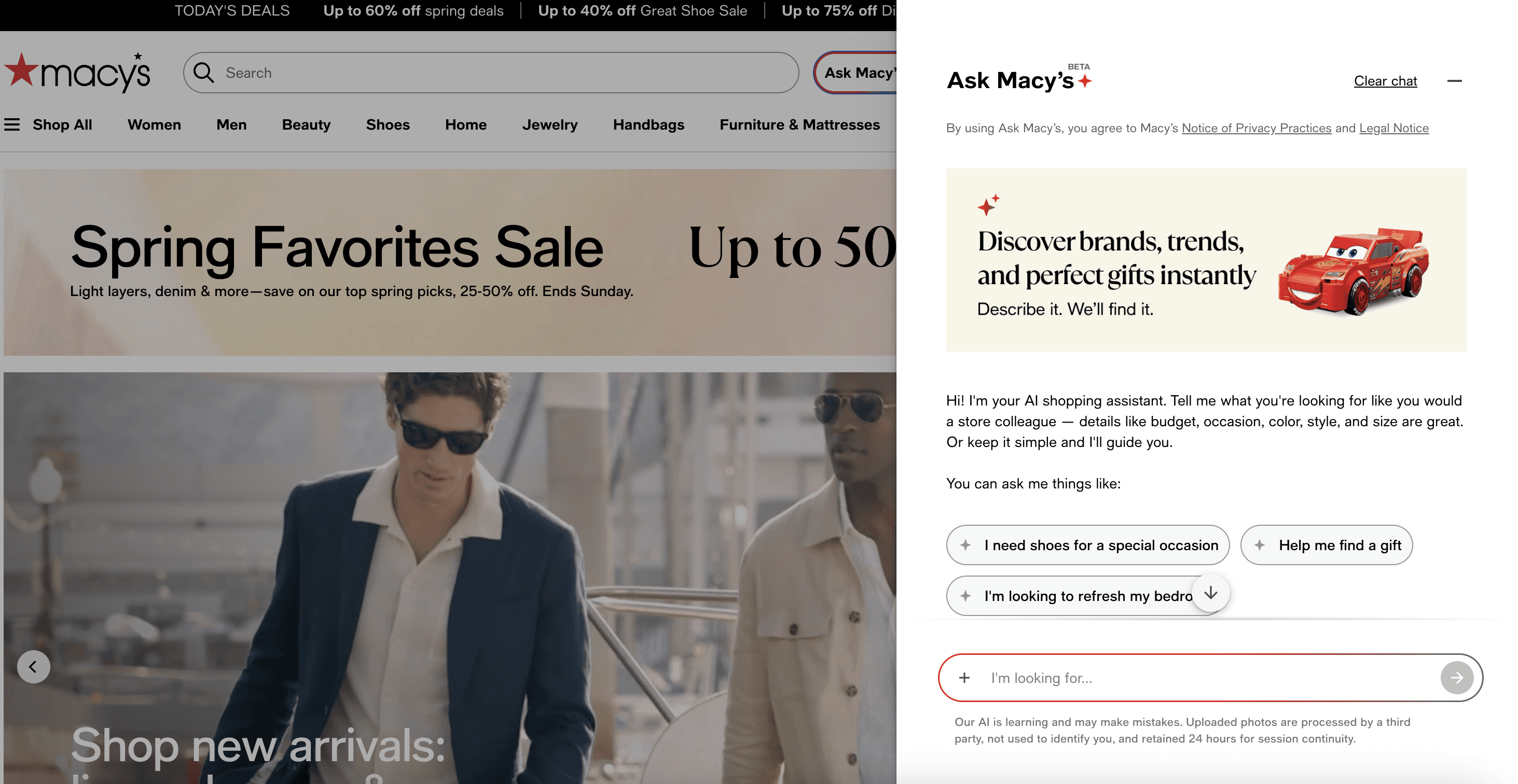
Macy’s, the $22bn-a-year retailer, has launched its own on-site shopping agent, Ask Macy’s. Early reports show that revenue per visit is 4.75 times higher among customers who use the assistant compared to those who do not.
The agent, powered by Google Gemini, is designed to move beyond simple search. Its stated goal is not just to return results, but to understand intent. Shoppers are encouraged to describe what they need as if speaking to a store colleague, sharing details such as budget, occasion, colour, style, and size.
Macy’s now joins retailers such as Amazon, Walmart, and Target in deploying on-site AI agents that guide discovery, reduce decision friction, and increase basket size.
For brands, this marks a structural shift. For decades, product visibility has been shaped by keyword search and merchandising rules. Now, recommendations are being mediated by models that interpret context, weigh trade-offs, and make probabilistic decisions.
The practical question is simple. How do you ensure your products are surfaced and recommended by these systems?
The answer is less simple. It depends on the retailer, the product feed, and the model itself. But looking specifically at Gemini-powered systems and early testing of Ask Macy’s, a clear set of patterns is emerging.
How to optimise your PDP for Gemini-powered agents
1. Be specific about who your product is for
Generic descriptions do not perform well in an AI-mediated environment. They give the model very little to anchor to, and as a result, your product becomes interchangeable with dozens of near-identical options.
Instead of describing what a product is, describe when and why it is used. The model is trying to match a shopper’s situation to a product that fits, not just retrieve items that share keywords.
This requires a shift from category-led thinking to scenario-led thinking. Define the context with precision. Where is the customer. What are they doing. What constraints matter. What outcome are they prioritising. The more specific the scenario, the easier it is for the model to map intent to product.
How to make this actionable for Macy’s
Write a single, explicit “designed for” statement for each core product
Example: “Designed for city travellers visiting cold, windy destinations in early spring who want warmth without bulk”Integrate usage context directly into titles, feature bullets, and descriptions rather than isolating it in brand copy
Break out multiple use cases within the PDP instead of relying on one generalised description. For example, separate sections for commuting, travel, and outdoor use
Include constraint-based language where relevant, such as “packable”, “lightweight”, “formal but comfortable”, or “suitable for long wear”
If the model understands the scenario clearly, it can recommend your product without needing to infer missing context. That increases both the likelihood of selection and the confidence of the recommendation.
2. Enrich your catalogue with decision-making attributes
Traditional attributes such as size, colour, and price are necessary, but they are no longer sufficient in isolation.
AI agents are not just filtering down a list. They are reasoning through options. They need attributes that help them evaluate trade-offs between products, especially when a shopper query includes multiple constraints.
Shoppers are now searching with long, highly specific prompts. Structured attributes are often the first place the model looks to resolve these queries before it turns to descriptive text.
Attributes worth prioritising for Macy’s
Product dimensions
Material composition
Product weight
Care instructions
Beyond these basics, brands should consider expanding into attributes that capture performance and experience. For example:
Warmth level or insulation type
Fit profile such as slim, relaxed, or oversized
Breathability or stretch
Durability or intended frequency of use
These attributes allow the model to make more nuanced decisions. They also make your product eligible for a wider range of queries that go beyond simple filtering.
A well-structured product is not just easier to find. It is easier to justify. The more clearly a product signals what it offers, and what compromises it involves, the more confidently it can be ranked and recommended.
3. Use real-world validation that reduces uncertainty
AI systems are trained to discount vague, unsubstantiated claims. Phrases like “high quality” or “best in class” carry little weight unless they are supported by evidence.
What matters is whether the information available reduces uncertainty for the shopper. Reviews and user-generated content are particularly powerful when they provide concrete, situational detail.
What works better
Reviews tied to a specific time, place, or condition
Example: “Wore this walking 20,000 steps a day in Chicago in March”Explanations of why the product was chosen over alternatives, which helps the model understand trade-offs
Signals of repeat use or repurchase, which indicate long-term satisfaction rather than one-off approval
Mentions of fit, comfort, durability, or performance over time
How to operationalise this for Macy’s
Seed products with high-value or highly engaged customers to generate detailed, experience-led reviews
Prompt reviewers with questions that encourage specificity, such as “Where did you use this?” or “What problem did this solve?”
Encourage multimedia feedback, including images or short videos, which provide additional context
Respond to shopper questions with clear, detailed answers, as these interactions become part of the information layer the model can draw from
AI systems are effectively looking for evidence that lowers the perceived risk of a purchase. Specific, experience-based validation does this far more effectively than polished marketing copy.
4. Optimise for shopper behaviour, not just content
One of the most used features within Ask Macy’s is “complete the look”. This signals a broader shift in how products are being surfaced.
The agent is not just selecting individual items. It is assembling outcomes that align with the shopper’s intent.
For fashion brands in particular, this means that relationships between products need to be explicit and structured, not implied.
How to act on this
Set up “pair it with” or “complete the look” associations across PDPs so products are linked in a meaningful way
Ensure complementary items are consistently connected, such as tops with bottoms, or outfits with accessories
Maintain consistency in styling, naming, and categorisation so the model can recognise which items belong together
Reflect real shopper behaviour by linking products that are commonly purchased or worn together, not just those that are visually similar
This allows the model to map connections between products and recommend combinations rather than single items. In turn, this increases basket size and improves the overall relevance of recommendations.
The underlying shift is subtle but important. Optimisation is no longer just about making a product easy to find. It is about making it easy for the model to place that product within a broader solution.
Beyond the PDP: building brand authority with AI
Initial testing of Ask Macy’s suggests a clear pattern. Recognisable brands are surfaced more often than lesser-known challengers, even when product attributes are comparable.
This signal does not come from the retailer feed. It comes from the model’s prior knowledge.
Systems powered by Google Gemini are shaped by the open web. Brand websites, press coverage, third-party reviews, and social discourse all contribute to how “confident” the model feels when recommending a product.
That confidence directly influences ranking.
This creates a compounding advantage. Brands with strong, consistent representation across the web enter the recommendation process with a head start that cannot be replicated through PDP optimisation alone.
The implication is straightforward. Brand is no longer just a marketing function. It is a ranking input.
The question then becomes practical. How do you actively build brand authority in a way that these systems recognise and reward?
1. Structure your brand presence so models can parse it
AI systems favour information that is clear, consistent, and easy to interpret.
If your brand information is fragmented or inconsistent across channels, the model has less confidence in using it as a signal.
How to act on this
Ensure your brand description, product taxonomy, and key messaging are consistent across your website, retailer listings, and third-party platforms
Use structured data on your own site so product details, materials, and use cases are machine-readable
Maintain clean, standardised naming conventions across products and categories
The goal is not just visibility. It is interpretability. The easier your data is to parse, the more likely it is to be used.
2. Expand your presence across high-signal sources
Not all mentions are equal. AI models place more weight on sources that appear credible, detailed, and widely referenced.
A handful of strong, information-rich sources is often more valuable than broad but shallow coverage.
Where to focus
Editorial coverage that discusses your products in context
Detailed product pages on your own domain
High-quality retailer listings with complete information
Review platforms where customers describe real usage
How to act on this
Invest in press and editorial placements that explain when and why your product is used, not just that it exists
Publish detailed product content on your own site that mirrors and reinforces retailer listings
Ensure your products are present and well-described on key marketplaces, not just your primary retail partner
This builds a consistent footprint that the model can draw from when forming its understanding of your brand.
3. Generate consistent, context-rich mentions
Models do not just recognise brand names. They associate them with specific use cases, qualities, and outcomes.
If your brand is mentioned repeatedly in similar contexts, that association becomes stronger.
How to act on this
Encourage reviews and user-generated content that describe specific scenarios of use
Work with creators or publications to position your product within clear contexts, such as travel, workwear, or occasion-based dressing
Reinforce the same use-case language across campaigns, product pages, and external content
For example, a brand consistently associated with “lightweight travel jackets for variable weather” becomes easier for the model to retrieve when that scenario appears in a query.
4. Align your owned and retailer content
A common failure point is misalignment between what a brand says on its own channels and what appears on retailer PDPs.
If these differ, the model receives conflicting signals.
How to act on this
Ensure product descriptions, materials, and use cases match across your own site and retailer listings
Syndicate enriched content, including use cases and attributes, into retailer feeds where possible
Regularly audit retailer PDPs to ensure they reflect your most up-to-date positioning
Consistency across surfaces reinforces credibility. Inconsistency weakens it.
The open web now functions as a training layer for retail AI. Every piece of structured product data, every contextual mention, and every detailed review contributes to how your brand is understood.
The brands that recognise this early will not just be more visible. They will be more trusted, and in an AI-mediated environment, that trust is what drives selection.
How Azoma helps brands optimise for this shift
Azoma helps brands become visible and competitive in AI-driven retail environments.
It structures and enriches product data so models can interpret it properly, adding scenario-based context, decision-making attributes, and consistency across PDPs, retailer feeds, and owned channels. This makes products easier for AI systems to match, compare, and recommend.
Beyond the PDP, Azoma strengthens the signals that shape brand confidence. It identifies gaps in how your brand and products appear across the web and ensures you are consistently represented in the sources AI models rely on.
It also gives you visibility into performance across agent-led experiences, including Amazon Rufus, Walmart Sparky, ChatGPT, Gemini, and Ask Macy’s, so you can understand when your products are being surfaced, what is driving selection, and where you are losing out.
➡️ If you want to see how your brand performs in these environments, and what to do to improve it, get in touch for a demo.
Summing Up
Retail is entering a new phase where discovery is no longer driven by search alone, but by systems that interpret intent and make decisions on behalf of the shopper.
In that environment, the unit of competition shifts. It is no longer enough for a product to match a keyword. It needs to match a situation. It needs to justify itself against alternatives. And it needs to be backed by signals the model can trust.
Three changes define this shift.
First, product data needs to become more specific, structured, and scenario-driven.
Second, validation needs to move from generic claims to real, contextual evidence.
Third, brand needs to be built not just for people, but for the systems that decide what people see.
The brands that adapt to this will not simply rank higher. They will be selected more often, across more contexts, and with greater confidence.
The ones that do not will still exist in the catalogue, but increasingly, they will not be surfaced.

Article Author: Max Sinclair