
60% of Amazon Shoppers Now Use Rufus and Those Who Do Purchase 2.74x More: How to Prepare Your Brand Today
Last Updated:
The data is in, and it should change how every brand thinks about Amazon.
In a recent episode of The New Frontier podcast, hosted by Azoma, Sensor Tower's SVP of Innovation Ian Simpson shared findings from a landmark study tracking 60,000 real US Amazon shoppers over 18 months. The results are some of the clearest evidence yet that AI shopping assistants are no longer a fringe behaviour. They are now central to how the most valuable Amazon customers buy.
Two numbers stand out.
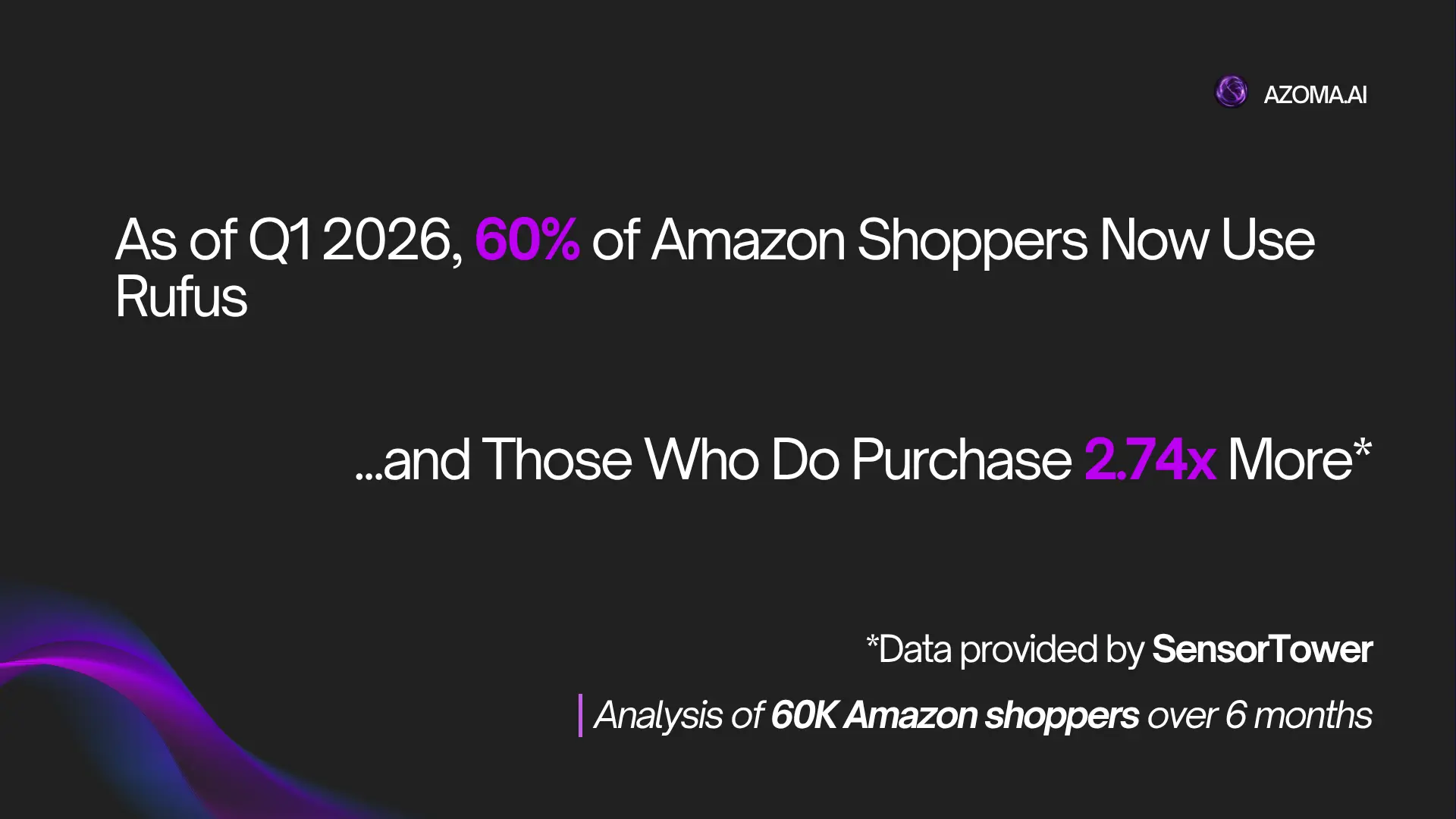
60% of heavy Amazon users now include Rufus in their shopping sessions.
Shoppers who use Rufus are 2.74x more likely to convert than those who don't.
These are not projections. They are observed behaviours from a dedicated panel of 60,000 US shoppers, tracked across both mobile and web, over a six month window covering Black Friday 2025 through Q1 2026.
Read on for our full breakdown or watch the podcast below:
What the Numbers Actually Mean
Sensor Tower's panel methodology is worth understanding before unpacking the implications. The 60,000 shoppers in this cohort had been part of the panel for at least 18 months, giving Sensor Tower a stable baseline of behaviour to compare against. Privacy compliant tracking captured shopping signals across mobile devices and desktop, and Sensor Tower deliberately isolated proper shopping sessions from other Amazon activity like returns, account checks, or shipment tracking.
Within this cohort, the conversion picture is striking:
Shoppers who did not use Rufus converted at around 21%
Shoppers with some Rufus usage converted at 30 to 40%
Heavy Rufus users converted at 58%
A "heavy user" in this context is someone shopping on Amazon roughly once every three days or more. And these are the shoppers driving 60% Rufus adoption.
The Causation Question
The natural question is whether Rufus is causing higher conversion, or whether buyers are simply more likely to use Rufus. Sensor Tower's team, working alongside Azoma, dug into exactly this.
The answer reframes the entire conversation.
When Amazon ran its Spring Sale from March 25th to 30th, Rufus usage among the same dedicated cohort dropped sharply, while non Rufus shopping sessions rose. Once the sale ended, Rufus usage snapped back to normal levels.
The pattern reveals the mechanism. During promotional events, shoppers come to Amazon to browse deals. They click through curated landing pages, scan product pages, and bail. They are not in dialogue with an assistant because they are not searching for something specific. Conversion rates dropped roughly 10 percentage points during the sale period, even with elevated traffic.
As Ian put it on the podcast:
"People do not use Rufus because they want to browse. They use Rufus because they want to buy. That's why the headline is shoppers are supercharging Rufus, not Rufus is supercharging shoppers."
This is the insight that matters most for brands. The shoppers most likely to purchase your product are the ones using Rufus to find it. If your PDP is not optimised for how Rufus reasons, retrieves, and recommends, you are invisible to the most valuable segment of Amazon's audience.
Why This Tracks With Amazon's Own Reporting
Andy Jassy stated on Amazon's Q3 earnings call that customers who use Rufus are 60% more likely to complete a purchase, and that Rufus is on track to drive over $10 billion in incremental annualised sales.
Sensor Tower's findings independently validate this, and arguably go further. Amazon used a 7 day attribution window in its reporting. Sensor Tower used a single day attribution window, meaning a Rufus interaction only counted if a purchase happened the same day. The conversion uplift held across this much tighter methodology.
The cross validation matters. It is one thing for Amazon to claim Rufus drives sales. It is another for an independent panel of 60,000 real shoppers to confirm it across both mobile and desktop, with consistent patterns across every cohort cut Sensor Tower performed.
What This Means for Brands
The Rufus adoption curve is not theoretical anymore. The shoppers who buy most often, return most often, and spend most often on Amazon are using AI to find products. That changes the brief for every brand selling on the platform.
Three implications stand out:
Rufus is your highest intent traffic. The 58% conversion rate among heavy Rufus users is not a rounding error. It reflects a self selecting group of buyers who are actively looking to transact. If your product is not surfaced by Rufus for the queries your buyers are asking, you are losing the most valuable shopping moments on Amazon.
Keyword density is no longer the game. Rufus reasons over PDPs the way a well informed sales associate would. It reads bullets, A+ content, Q&A, reviews, and visual overlays to understand what a product is, who it is for, and why it solves a problem. Brands optimising for Rufus need to write in complete noun phrases, map features to benefits explicitly, and seed Q&A content that mirrors how shoppers actually ask questions.
The window is open, but it will not stay that way. Rufus is evolving from a conversational interface into an action based agent that can execute multi step shopping tasks, hold memory of household preferences, and increasingly transact on the shopper's behalf. The brands that build the muscle now will be the ones whose products get surfaced when AI agents start doing the buying directly.
As Ian said toward the end of the conversation, this is less a train leaving the station and more a relay race already in motion. You do not start from zero when you take the baton. You run alongside the market as it moves, so when the next handoff happens, you are already at full speed.
Where Rufus Goes for Information: The Off-Page Picture
One of the most overlooked findings in recent Rufus research is where the assistant actually pulls information from when it leaves the Amazon ecosystem. Rufus is grounded in Amazon's catalogue, reviews, and Q&A, but it also reaches off-page to validate claims, compare alternatives, and answer category-level questions. The breakdown of those off-page sources tells brands exactly where to invest their content footprint.
Based on recent analysis of the third-party sources Rufus cites, carried out by Azoma, the picture looks like this:
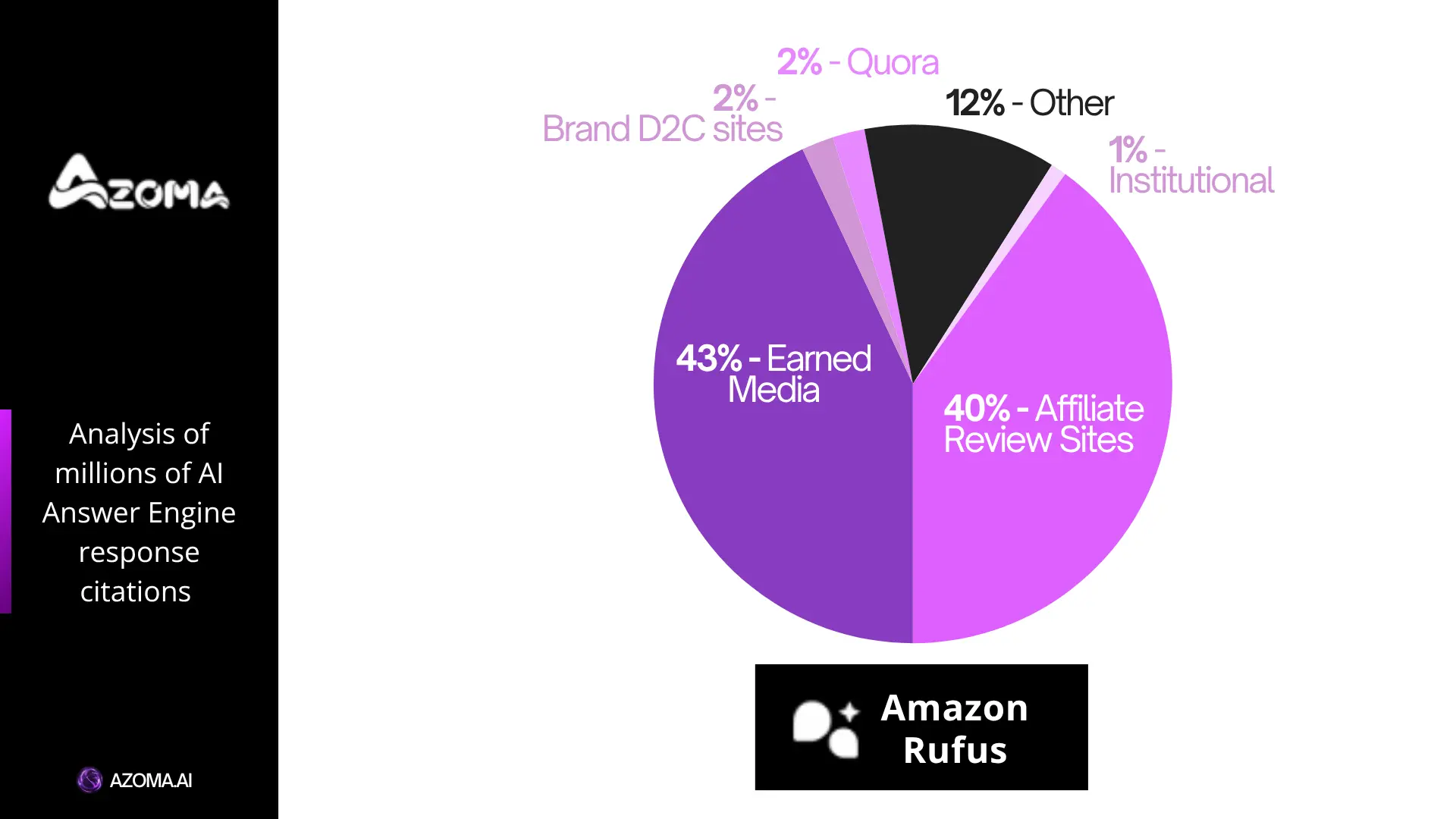
43% Earned Media. Editorial coverage, press mentions, and journalist-led product roundups carry the most weight. This is the kind of coverage you cannot buy directly, but you can absolutely earn through PR, product launches, and category leadership content.
40% Affiliate Review Sites. Sites like Wirecutter, Tom's Guide, Good Housekeeping, and category-specific review hubs are a huge influence on what Rufus surfaces. Brands that are reviewed favourably across multiple affiliate sites have a structural advantage in how Rufus describes and recommends their products.
12% Other. A long tail of forums, blogs, and miscellaneous web sources.
2% Brand D2C Sites. Your own website does feature, but only marginally. Rufus weighs independent third-party validation far more heavily than self-published brand content.
2% Quora. Community-driven Q&A still carries some weight, particularly for question-style queries.
1% Institutional. Government, academic, and standards-body sources are cited rarely but matter for regulated categories.
The strategic implication is clear. If 83% of Rufus's off-page citations come from earned media and affiliate review sites, then traditional digital PR and reviewer outreach are now AI search optimisation activities. The press hits you secured for brand awareness in 2023 are now training data for the assistant deciding whether to recommend your product in 2026.
Brands serious about Rufus visibility need to think beyond the PDP. They need to be reviewed, ranked, and written about across the third-party web in the language Rufus expects to see.
➡️ If you want to understand the off-page sources Rufus cites in your Amazon category, get in touch with us for a demo of our Rufus intelligence product.
How to Optimise your PDP for Rufus Today
Beyond appearing in the off-page sources Rufus cites, the PDP is the core place brands can win and influence their share of voice. It is worth remembering that Rufus does not work alone. It sits on top of COSMO, Amazon's commerce knowledge graph, which interprets every PDP as a structured object with attributes, relationships, and use cases. Rufus handles the conversation, but COSMO decides what your product actually is, who it is for, and whether it is the right answer to the shopper's question.
Pulling together the on-page guidance from the recent Azoma x Digital Shelf Institute Whitepaper, here are the seven core levers brands should be pulling right now to make their PDPs Rufus and COSMO-ready:
1. Noun Phrase Usage
Use complete, descriptive noun phrases consistently across titles, bullets, A+ content, and Q&A. Each phrase should clearly define the product's type, material, function, and context of use. Replace fragmented keywords like "laptop backpack, water resistant" with full phrases like "water-resistant laptop backpack for travel". Rufus extracts and weights noun phrases to match shopper intent in natural language queries.
2. Backend Attributes
Complete every available attribute, including function, intended audience, event or occasion, location or environment of use, and compatibility with other products. These fields feed COSMO's commonsense graph through relationships like used_for, used_by, and used_in, which is what enables correct intent matching beyond the surface text on your page. Empty attributes are invisible relationships.
3. Feature to Benefit Mapping
Stop listing specs without explaining why they matter. Structure bullets as "feature plus outcome", for example "Padded shoulder straps reduce strain during long commutes". Clear feature-to-benefit links allow Rufus to infer which products solve specific shopper needs.
4. Visual Label Tagging
Add short overlay text or labelled diagrams to key images that call out features, dimensions, compatibility, or included components. Limit overlays to two to four concise callouts per image. Rufus reads visual text via OCR and uses it for semantic matching, so what you label visually directly informs how the assistant describes your product.
5. Conversational Copy Style
Use natural, flowing language throughout the PDP and avoid keyword stuffing or overly technical phrasing. The simple test: read your content aloud. If it sounds unnatural, it is likely suboptimal for Rufus, which prioritises human-like language and semantic similarity over rigid keyword matches.
6. Alt Text for A+ Images
Write descriptive alt text for every A+ image, covering what is shown and how it is used, within 100 characters. Use sentence-style descriptions rather than keyword strings. Alt text supports Rufus's multimodal comprehension and improves consistency between text and visuals.
7. Review-Derived Questions
Mine your reviews for recurring questions and objections, then address them directly in bullets, images, A+ content, and the Q&A section. Focus on fit, durability, ease of use, and limitations, not just positives. This provides Rufus with authentic, real-world conversational signals that map directly to how shoppers ask questions.
➡️ Reach out to Azoma for insights into the most commonly asked Rufus shopper questions across your entire Amazon category.
These seven levers are the floor, not the ceiling. Combined with a strong off-page presence across earned media and affiliate review sites, they give your products the best possible chance of being surfaced, understood, and recommended by Rufus during the moments that matter most.
Where Azoma Fits
Azoma exists to help global brands like Mars, HP, and Lipton control how their products are understood by AI shopping assistants like Rufus. We translate how these systems actually reason into practical, measurable optimisations across Amazon, Walmart, ChatGPT, Gemini and the broader agentic commerce stack.
If 60% of heavy Amazon shoppers are using Rufus, and those shoppers convert at nearly 3x the rate of everyone else, the question is not whether to optimise for Rufus. The question is how quickly you can.
➡️ Get in touch with us today for an assessment of your PDP & off-page readiness for Amazon Rufus.

Article Author: Max Sinclair