
Alexa for Shopping now speaks first: What agent-initiated discovery means for AI visibility
Last Updated:
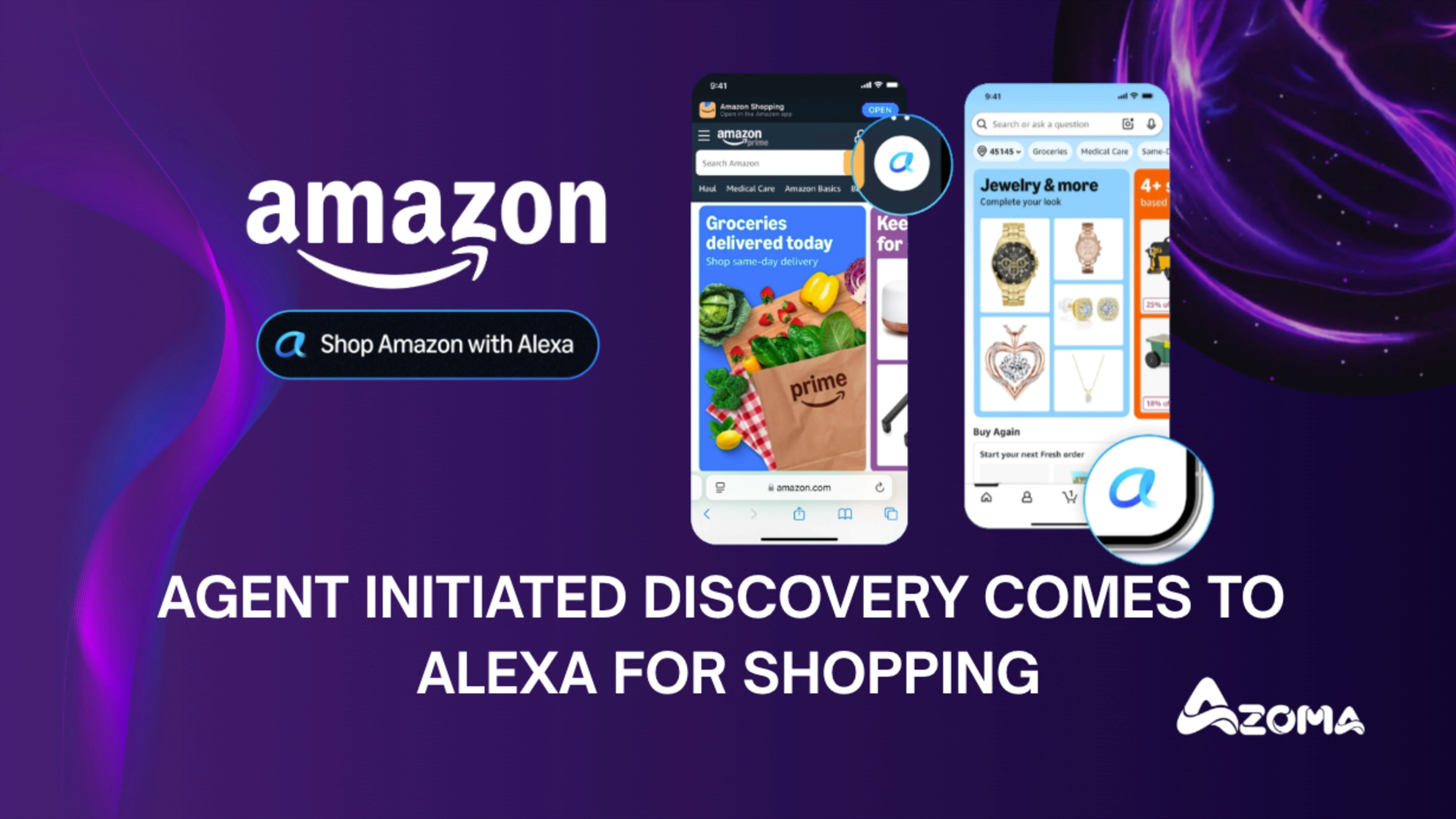
Amazon has switched on Update Me When inside Alexa for Shopping. The assistant now monitors Amazon and the wider web on a shopper's behalf and sends a personalised notification when something relevant happens, without being asked again. It shipped on 1 September 2026, alongside a batch of other shopping features.
Taken together with the rest of Tuesday's batch, this is Alexa for Shopping completing its transition from an AI chatbot into a full shopping agent. Amazon has moved the starting point of the shopping occasion, and it no longer begins with a shopper typing a question. Rajiv Mehta, VP of Conversational Shopping at Amazon, describes the assistant as now keeping "track of the things you care about" across both Amazon and the open web.
The prediction we made in May just shipped
When Rufus came out of beta as Alexa for Shopping in May, we closed on where it was heading: Alexa moving from answering questions to acting autonomously, building carts, tracking prices, scheduling reorders.
Four months later, that is exactly what has landed. Mehta is quoted in both announcements. The direction of travel we flagged then is now a shipped product with a name.
The strategy has held steady since May. What moved is the trigger, which now sits with the agent rather than the shopper.
What actually changed on 1 September
1. Update Me When: standing interests, monitored continuously.
A shopper registers an interest once and Alexa monitors for it indefinitely. Amazon's own examples cover a favourite brand launching a new product line, a new season of a show, an artist announcing a tour, an author releasing a book, and a tech company confirming a ship date. The assistant searches Amazon's catalogue and the broader web, then sends a personalised alert.
Shoppers set them conversationally, with requests like "Update me when a new Kindle releases". The alerts are configured in the Amazon Shopping app or on Amazon.com.
2. Scheduled Actions and Auto-Buy: the agent transacting on its own.
Scheduled Actions lets a shopper set up recurring, personalised shopping tasks: restocking pet food, paper towels and detergent, adding healthy kids' snacks monthly, or surfacing gift ideas ahead of birthdays. Alexa handles the product research, then either notifies the shopper or drops items straight into the cart for review.
Auto-Buy goes a step further. A shopper can say "Buy these headphones when they're 30% off" and Alexa will monitor the price, then complete the purchase using their default payment method when the target is hit. No human is present at the moment of transaction.
3. Generative comparison tables, and a Compare with Similar button on every PDP.
Shoppers can now select multiple products straight from search results and Alexa will compare them side by side on features, prices and reviews. The same capability sits on every product detail page behind a "Compare with Similar" button.
That is a fully generative comparison experience, assembled by the agent rather than laid out by the retailer. Your product is being lined up against its competitors on attributes the agent chooses to surface.
All three features share the same property, and it is the one that matters. The agent decides which products satisfy the instruction, and it does so when no shopper is watching.
Agent-initiated discovery is a new category of problem
Agent-initiated discovery is any product recommendation an AI shopping agent surfaces without a shopper query immediately preceding it. The trigger is a standing instruction, a purchase history, a followed interest or a schedule. The agent, not the shopper, decides which products satisfy it.
Most AI visibility work assumes a query exists to optimise against. Agent-initiated discovery removes the query from the moment of surfacing, which leaves attribute data doing the work instead.
What replaces it is attribute resolution. In query-led discovery, a brand competes to be the best answer to a question a shopper has phrased. In agent-initiated discovery, a brand competes to be legible enough that an agent can match it to an interest that shopper registered weeks ago. An agent can only resolve attributes that are actually present in the product data.
This is worth being precise about, because agentic commerce optimisation overlaps heavily with what is variously called GEO (generative engine optimisation), AEO (answer engine optimisation), and AI search optimisation. The distinctions are mostly emphasis: GEO names the technology producing the answer, AEO names the behaviour being optimised for, and agentic commerce optimisation names the case where the answer ends in a purchase. Update Me When sits squarely in the third.
What are the implications for brands
The 5 C's of Agentic Commerce still hold. The weighting between them shifts.
Completeness stops being about the attributes shoppers ask about and becomes about every attribute an interest could be phrased around, including category, occasion and succession. Context has to make product succession explicit: what this replaces, updates or follows. Citations matter more, not less, because a launch with no external footprint is invisible to an agent scanning the open web for it.
Correctness carries the heaviest new load. Release dates, generation labels and version naming are what succession matching runs on, and most catalogues carry that relationship in marketing copy rather than in structured attributes. Customer acquisition changes character entirely: the shopper who arrives from an alert was told rather than asked, and arrives with no comparison set at all.
That last point has a commercial edge to it. A notification arrives as a single alert with no comparison set attached, which is a different starting position from a results page. What that does to conversion is not something anyone outside Amazon can currently measure.
The comparison tables work in the other direction, and both are live at once. Alexa chooses the attributes it compares on, drawing them from product data, so an attribute a brand has left vague or unstructured is one it cannot be represented on. This is Completeness in the 5 C's, applied to a table the brand does not control.
What brands should do today to optimise for Alexa for Shopping
The Rufus and COSMO foundations from May all still apply. Six things sit on top of them, and each maps to one of the 5 C's of Agentic Commerce.
1. Publish launches in a form an agent can date and attribute. (Citations)
An agent asked to flag a new product line has to establish that something is new, when it became new, and who made it. Only a dated, attributable page with structured product data supplies all three. A campaign asset leaves the agent guessing on every one of them.
2. Make succession explicit in structured data. (Correctness)
"The new one" is a resolution problem. Every product needs a machine-readable answer to what it replaces, what generation it is, and what it follows. If a human has to read your marketing to work out which model is current, an agent cannot.
3. Treat category authority as a discovery asset. (Citations)
Alexa draws on licensed content partners and information from across the web, which means the agent is choosing whose launch is worth a notification. Editorial coverage, retailer content and category guides feed that decision.
4. Get repeat-purchase products into Scheduled Actions. (Customer acquisition)
Conversational reorders and Scheduled Actions work from products a shopper has already bought. That gives consumables and Subscribe & Save categories additional strategic weight, because a recurring instruction sits at the agent layer rather than being re-decided at each purchase.
5. Make your comparable attributes explicit. (Completeness)
With side-by-side comparisons now native to search results and sitting on every PDP behind a button, shoppers will routinely see your product evaluated against competitors on features, price and reviews. Differentiators buried in marketing language do not make it into a generated table. Stated, structured, comparable attributes do.
6. Baseline where you actually stand before changing anything. (Context)
Alexa for Shopping optimization tools exist to answer one question: how does the assistant currently answer shopping queries in your category, and where do your products sit in those answers. The practical test of any Alexa for Shopping tracker is whether it reports at ASIN level rather than as a single brand score, whether it surfaces the shopper questions behind each mention, and whether it routes from a finding to a listing change.
A portfolio-level score can hide the individual SKUs that are absent from answers, and those are the ones an agent has nothing to match against.
➡️ Azoma tracks Alexa for Shopping at ASIN level, with the prompts and shopper questions behind every mention, so you can see which products are being retrieved and which are absent from the answer entirely.
What this does not mean
Two overclaims are already circulating, and both are wrong.
Agent-initiated discovery does not mean prompts stop mattering. Every alert starts life as a shopper prompt: Amazon's own framing is that shoppers configure these themselves, conversationally, in the app. TechCrunch notes that consumers currently have to set the alerts up directly, while suggesting Amazon may eventually generate or recommend them. That future is plausible and it has not shipped, so planning against fully autonomous surfacing today is planning against a product that does not exist yet.
It also does not mean brands can influence notifications directly. There is no placement to buy and no notification inventory. The influence available is upstream, in whether your product data and external coverage make a launch resolvable at all.
Important caveat: nobody outside Amazon can currently measure notification-level share of voice. Query-led visibility is a proxy for a system that now also acts unprompted, and it should be described as one. Update Me When is also US only at launch, with no published rollout timetable for other markets.
Summing Up
Alexa for Shopping has been on a single trajectory since Rufus launched in February 2024: from answering, to comparing, to acting. Update Me When is the point where it starts the conversation itself.
For brands, the Rufus playbook still applies. What has changed is that a listing now has to be legible to an agent with no question attached to it, matched against an interest a shopper described in their own words weeks earlier. Explicit, dated, structured product data is what makes that match possible.
Amazon's search bar already routes questions to Alexa rather than to a results page, and the notification is now a discovery surface in its own right. On both, the agent works from what your product data actually states. A catalogue that cannot answer what is new and what it replaces gives the agent nothing to match, and the answer goes to a catalogue that can.
Azoma is built for exactly this. We track how AI shopping agents retrieve, compare and recommend products across Alexa for Shopping, Walmart Sparky, ChatGPT and Gemini, and we optimise listings at scale across Amazon, Walmart and Target. Get in touch today for an assessment of your catalogue's readiness for agent-initiated discovery.

Article Author: Max Sinclair